Everest is the higher mountain. That is the one fact everyone knows about the two highest peaks on Earth, and it is about the least interesting thing you can say about them. On almost every other measure, from difficulty and danger to how often anyone stands on top, the second-highest mountain in the world has historically been the harder, rarer and more serious summit.
K2 vs Everest in one line: Everest is higher, at 8,848.86 m (29,032 ft) against K2’s 8,611 m (28,251 ft), a gap of about 238 m. But K2 is steeper, more remote and stormier, it was first climbed a year later, it held out in winter until 2021, and it has seen only a small fraction of Everest’s thousands of summits.
Here are the two mountains side by side, and what each number really means.
K2 vs Everest at a glance
| Everest | K2 | |
|---|---|---|
| Height | 8,848.86 m (29,032 ft), 2020 Nepal-China survey | 8,611 m (28,251 ft) |
| Range | Mahalangur Himal, Himalaya | Karakoram |
| Borders | Nepal and China | Pakistan-administered and China-administered territory |
| Prominence | Highest on Earth (special case) | 4,020 m (13,189 ft) |
| First ascent | 29 May 1953 | 31 July 1954 |
| First winter ascent | 17 February 1980 | 16 January 2021 |
| Summits | 13,737 (through December 2025) | about 800 (as of August 2023) |
| Deaths | 339 (through December 2025) | 96 (as of August 2023) |
The summit and death totals come from different compilations with different cut-off dates, so read them as orders of magnitude rather than precise ratios. Everest’s figures are from Alan Arnette’s annual tally; K2’s are the August 2023 estimate quoted in the standard reference works.
How much taller is Everest than K2?
About 238 m, or roughly 780 ft. Everest’s 8,848.86 m comes from a joint survey by Nepal and China announced in 2020. K2’s standard figure is 8,611 m, and a 2014 satellite-based measurement came out within a couple of metres of it, at 8,609.02 m.
For a brief moment in the 1980s the order looked uncertain. A 1986 expedition produced a measurement suggesting K2 might be taller than Everest, and it took a corrected survey in 1987 to put the record straight. The episode is a good reminder that even the most famous heights are measurements, with all the caveats that go with them.
The prominence numbers tell a related story. Everest has no conventional prominence figure at all, because there is no higher ground to drop to; the reason is explained in why Everest has no prominence. K2’s prominence is 4,020 m, which makes it the most prominent peak in the Karakoram (see mountain height vs prominence for how the two numbers differ). The lowest point on the highest path from K2 to Everest is at the Kora La, at about 4,594 m, and K2’s prominence is essentially its height above that distant pass.
Why is K2 harder than Everest?
The reasons are geography rather than reputation.
Steepness. Everest’s standard routes involve long, dangerous glacier and ridge travel at extreme altitude, but they are not, for the most part, steep technical climbing. K2 is a steep pyramid on all sides, and its routes involve sustained climbing on rock and ice high on the mountain.
Latitude and weather. K2 lies well north of Everest, and the standard references put part of its difficulty down to that northern location, where bad weather is more common. That matters on a mountain where descent is slow.
Remoteness. Everest’s south side has a road-and-trail approach lined with villages. K2’s base camp is reached by a long trek up the Baltoro Glacier, far from settlements.
Those differences show up most starkly in the winter record. Everest’s first winter ascent came on 17 February 1980, by the Polish climbers Krzysztof Wielicki and Leszek Cichy. K2 was the last of the fourteen 8,000 m peaks to be climbed in winter, by a team of ten Nepali climbers on 16 January 2021, 41 years later.
The story of how K2 earned its nickname, and the danger statistics behind it, is told in why K2 is called the Savage Mountain.
Which is more dangerous?
Historically, K2, by a long way. Before 2021, roughly one person died on K2 for every four who reached the summit. Everest’s equivalent ratio has been a small fraction of that for many years.
The gap is closing, though, and for the same reason on both mountains: commercial expeditions. Fixed ropes, bottled oxygen and large support teams have turned K2 into a guided peak. ExplorersWeb described the 2022 season, when 145 climbers summited K2 in a single day, as the moment the mountain began to look like Everest. More summits mean a lower death-per-summit ratio even if the mountain itself has not become any safer.
Those ratios are slippery numbers, built from different counts of deaths and ascents, and the careful way to read them is laid out in which is the deadliest mountain in the world. The short version: K2 is still the more serious mountain, but the old “one in four” figure no longer describes the present.
Which one can you actually see?
There is one more difference, and it matters to anyone who just wants to look at them.
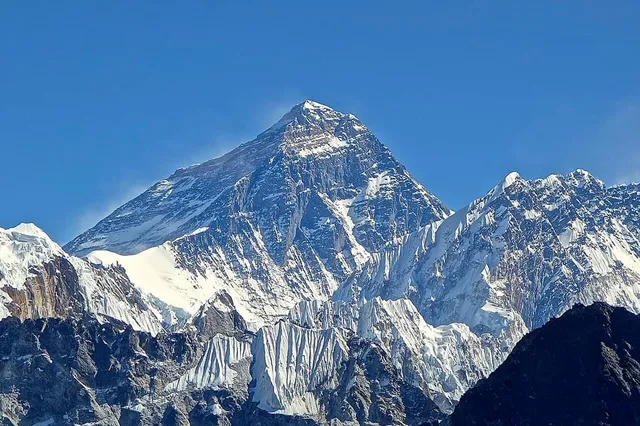
Everest is visible from a long list of trekking viewpoints and from mountain flights out of Kathmandu, although its dark summit pyramid is often half-hidden behind the ridge joining Nuptse and Lhotse.
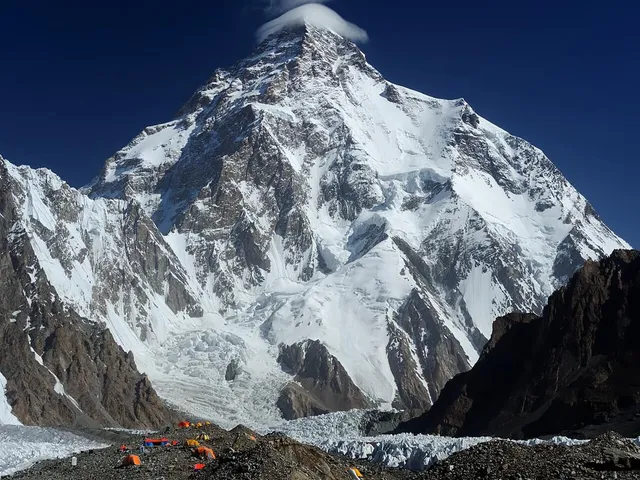
K2 hides. It is not visible from Askole, one of the last villages on the approach, and is only glimpsed briefly from the end of the Baltoro Glacier. When it does appear, it is the classic steep, free-standing pyramid that photographs make it out to be.
Neither is the “tallest mountain” by every measure. Measured from the centre of the Earth, both lose to a volcano in Ecuador, for reasons covered in Chimborazo vs Everest.
And from a distance, both are easy to get wrong. Trekkers regularly photograph a nearer, more dramatic summit believing it is the famous one. If you are looking at a big Himalayan or Karakoram skyline and want to know which peak is which, point your camera at it and Mountain Identifier will name it, with its height and prominence.
The real peaks
Genuine photographs of the summits above — so you know what to actually look for: