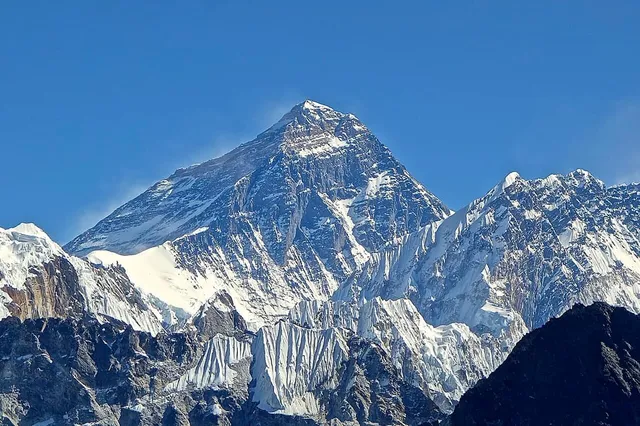

Look up any serious peak profile and you’ll find two numbers side by side: elevation and prominence. Except for one mountain. Check Everest and the prominence field does something odd — some lists leave it blank, some write “undefined” or “infinite”, and some quietly copy the elevation across. So why does Everest have no prominence, when every other summit on Earth gets a number?
Everest has no prominence number because prominence measures the drop from a summit to the lowest col connecting it to higher ground — and for Everest, no higher ground exists anywhere on Earth. With nothing to connect to, the measurement is undefined, so ranking lists mark it “infinite” or set it, by convention, equal to its full 8,848.86 m elevation.
That’s the whole answer in miniature. But the reasoning behind it is a nice tour of how prominence actually works — and it explains one of the stranger conventions in mountain statistics.
Prominence needs a higher neighbor
As we unpacked in elevation vs prominence, prominence answers the question: how far must you descend from this summit before you can climb to anything higher? The lowest point on the best such route is the key col, and prominence is simply the vertical distance from key col to summit.
Every step of that definition works for every mountain on the planet — except one. From any other summit, you can always trace a route that eventually reaches higher terrain: down a saddle, along a ridge, across a continent if necessary. The definition quietly assumes a higher peak exists somewhere. For Mount Everest, at 8,848.86 m (29,031.7 ft) — the figure from the joint Nepal–China survey announced in December 2020 — that assumption fails. Walk away from Everest’s summit in any direction, for any distance, and you will never reach a point from which you can climb higher. There is no key col, because there is nothing on the far side of any col that is taller.
No higher neighbor, no key col. No key col, no prominence. The number isn’t zero — zero prominence would mean the summit is a mere shoulder of something bigger, the exact opposite of the truth. It’s undefined, the way division by zero is undefined.
How the ranking lists handle it
List compilers still need Everest at the top of the prominence table — it would be absurd for the world’s most dominant summit to be missing from a ranking of dominance. So they adopt a convention, and you’ll see it in three flavors:
- Prominence equals elevation. The most common fix, used by Wikipedia’s list of peaks by prominence: treat sea level as Everest’s base, giving it a prominence of 8,848.86 m. This mirrors a rule already used elsewhere — the highest summit of any island or landmass has prominence equal to its elevation, because the sea is the ultimate col. Everest is simply the highest summit of the biggest landmass of all.
- Infinite or undefined. Purist sources refuse to invent a col and mark the field accordingly, ranking Everest first by special definition.
- “Dry” prominence. One playful variant drains the oceans: measure from the deepest seabed connection instead of sea level, and Everest’s prominence becomes its elevation plus the depth of the Challenger Deep — roughly 19,772 m by the figure Wikipedia’s prominence article carries. A thought experiment more than a statistic, but it shows how seriously prominence people take their cols.
Whichever convention a list picks, the outcome is the same: Everest ranks first, with an asterisk only pedants notice.
The real number two: Aconcagua
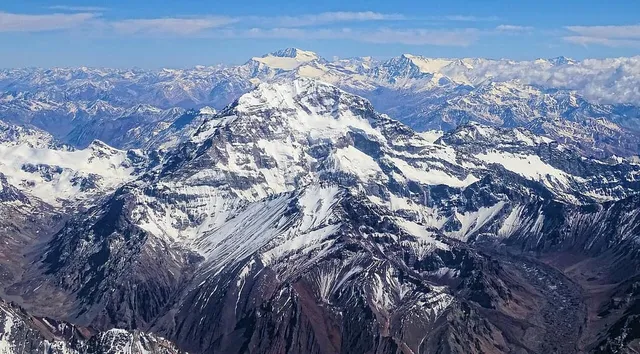
The convention has a tidy consequence: the world’s second most prominent peak is decided by the same landmass rule, fair and square. That peak is Aconcagua in Argentina — the highest mountain in the Americas, at roughly 6,961–6,962 m (about 22,840 ft) by the widely cited GPS surveys, though published figures vary by a few metres — Wikipedia’s current survey, the one our peak page uses, puts it at 6,967 m. Sources genuinely disagree here, so treat the last digit loosely.
What’s not in doubt is the prominence logic. The Americas contain no summit taller than Aconcagua, and the landmass connects to nothing higher — every route toward Asia’s giants drowns at the Bering Strait. So Aconcagua’s key col is effectively the sea, and its prominence equals its full elevation: near 7,000 m of pure, unshared rise. Second place on the prominence table, despite dozens of Asian peaks standing higher in elevation. It’s the cleanest illustration of what prominence rewards — not height, but independence.
Why this matters when you’re reading peak stats
Once you know the convention, oddities in mountain data stop looking like errors. An app or list showing Everest’s prominence as 8,848.86 m isn’t claiming somebody measured a col that doesn’t exist — it’s applying the landmass rule. A blank or ”∞” in the same field isn’t missing data — it’s the clearest version of the same fact. Both are telling you the identical thing: this is the point on Earth above which there is nothing.
It also sharpens your instinct for every other peak’s numbers. Prominence is always a statement about a real, findable saddle somewhere on the map — often surprisingly far from the mountain itself. Everest is the exception that proves the rule: the one summit whose defining saddle you could search for forever and never find.
When you point the app at a summit, both numbers come back side by side — and now you know why the biggest one of all technically only has one.
The real peaks
Genuine photographs of the summits above — so you know what to actually look for: