
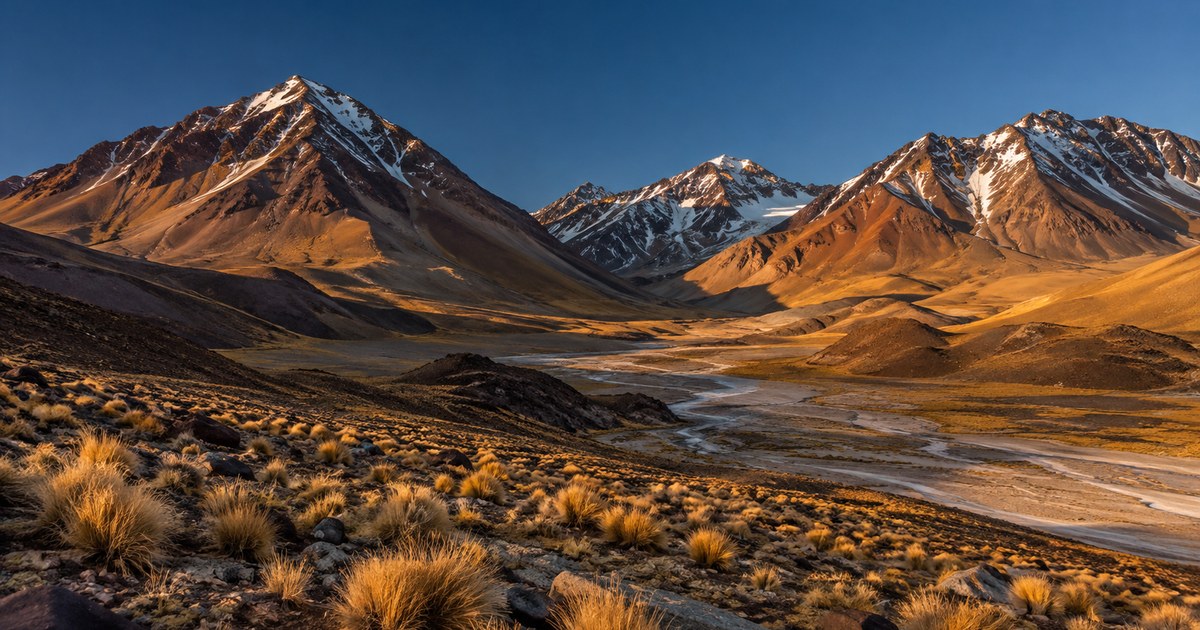
South America’s highest mountain is not hard to name. It is harder to pin to a single number. Depending on where you look, Aconcagua is 6,959, 6,961, 6,962 or even 6,967 m tall, and none of those sources is careless. The mountain is famous enough that it has been measured repeatedly, and each measurement used different tools and different definitions of sea level.
The highest mountain in South America is Aconcagua, at about 6,961 m (22,838 ft), in the Andes of Mendoza Province, Argentina, close to the Chilean border. It is the highest mountain outside Asia, which also makes it the highest point in the Americas and in the Southern Hemisphere. The current official Argentine figure, from a 2012 GPS survey, is 6,960.8 m.
What follows is why the number moves, how Aconcagua compares with the giants ranked behind it, and how to tell it apart when you see it.
How tall is Aconcagua?
For more than half a century, the official height came from a 1956 study by the University of Buenos Aires, which put the summit at 6,959.6 m. In September 2012, Argentina’s national geographic institute (IGN) presented, at the Universidad Nacional de Cuyo in Mendoza, the results of two years of GPS and gravity surveys by a group of national and foreign scientists: a new official figure of 6,960.8 m above mean sea level.
That is 1.2 m more than before, but the mountain did not grow. One of the scientists involved, from Argentina’s national geographic institute, cautioned at the time that the two measurements could not be directly compared because the technology was so different. The 2012 survey combined satellite positioning on the summit with gravity data, which is needed to convert a GPS height (measured against a mathematical model of the Earth) into a height above sea level. That conversion is where most of the disagreement between surveys comes from, on Aconcagua and on every other big mountain.
You will still see 6,962 m quoted widely, and some recent references give figures as high as about 6,967 m. Treat all of them as the same mountain described with slightly different assumptions. The differences are a few metres on a peak almost seven kilometres high. If you are curious why one mountain collects several heights, the general mechanism is the same one explained for Colorado’s peaks in why two maps give your mountain two different heights.
Why Aconcagua stands out so much
Aconcagua is not only the highest mountain in South America. It is also one of the most dominant mountains on Earth. Its prominence, the height it rises above the lowest col connecting it to any higher ground, is essentially its whole height, because there is no higher mountain anywhere outside Asia. That makes it the second most prominent peak in the world, after Everest, which itself has no prominence number by the usual definition. The difference between those two numbers, and why it matters for picking a summit out of a skyline, is covered in elevation vs prominence.
It is also one of the Seven Summits, the highest points of each continent, and its normal route is often described as non-technical, which is part of why it draws so many visitors, although it remains a serious high-altitude expedition. How the continental high points are chosen, and the arguments around them, are in the Seven Summits explained.
Aconcagua’s first recorded ascent was on 14 January 1897, by the Swiss guide Matthias Zurbriggen, on an expedition led by Edward FitzGerald.
Is Aconcagua a volcano?
It looks like one from some angles: a huge, isolated mass with a broad summit standing above its neighbours. And in the deep past, the area was volcanic; the mountain’s rocks include the remains of volcanic activity that ended a very long time ago. But today’s Aconcagua is not a volcanic cone with a crater. Its height comes from the Andes being squeezed and lifted as the Nazca Plate pushes under South America, and its shape from the erosion of that uplifted rock.
That is one reason it is easy to confuse with its tall neighbours to the north, many of which really are volcanoes.
The Andes giants behind Aconcagua
Several Andean summits come within a few hundred metres of Aconcagua:
- Ojos del Salado (about 6,893 m, 22,615 ft). On the Chile-Argentina border in the dry Puna de Atacama, and generally described as the highest volcano in the world. It is the second highest mountain in South America and the highest in Chile. Like Aconcagua, its height has been disputed over the years, with surveys ranging from about 6,880 m to more than 7,000 m before settling near the current figure.
- Monte Pissis. An extinct volcano in Argentina, generally ranked third in South America.
- Huascarán Sur (6,768 m, 22,205 ft). The highest mountain in Peru and the highest point anywhere in the Earth’s tropics, generally ranked fourth in South America.
Huascarán has one more distinction. Because it sits close to the equator, its summit is one of the farthest points on Earth from the planet’s centre, second only to Ecuador’s Chimborazo. That bulge effect, and why it lets a 6,263 m volcano beat Everest on one particular measure, is the subject of Chimborazo vs Everest.
Continental “highest mountain” questions often hide complications like these. Europe’s answer, for instance, depends entirely on where you draw the border with Asia, as explained in what is the highest mountain in Europe. South America’s answer, by contrast, is clean: whatever figure you use, Aconcagua is more than 60 m higher than anything else on the continent.
Spotting Aconcagua
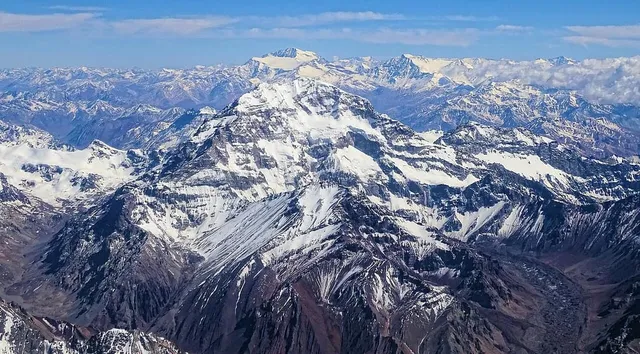
Aconcagua stands about 112 km (70 mi) northwest of the city of Mendoza and roughly 15 km from the Chilean border. It is set back from the main road over the Andes between Mendoza and Santiago, so you see it in glimpses rather than as a constant presence: a brown-and-white mass, usually streaked with snow, rising clearly above every summit around it. Its south face, a vast wall of rock and ice, is the side most travellers photograph from the valley below.
From a distance, though, the Andes are a sea of big, snow-streaked summits, and the highest one is not always the one that looks highest from where you stand. Nearer, lower peaks routinely block or outrank it by eye. If you are on that road and not sure which one you are looking at, point your camera at the skyline and Mountain Identifier will name the peak, with its elevation and range.
The real peaks
Genuine photographs of the summits above — so you know what to actually look for:
Sources
- Nueva altura oficial del cerro Aconcagua es de 6.960,8 metros (EFE), Telemetro
- Se dio a conocer la nueva altura oficial del Cerro Aconcagua: 6.960,8 metros, Instituto Geográfico Nacional (Argentina)
- Aconcagua, Wikipedia
- Ojos del Salado at last: climbing the world's highest volcano, Mark Horrell
- Huascarán, Wikipedia