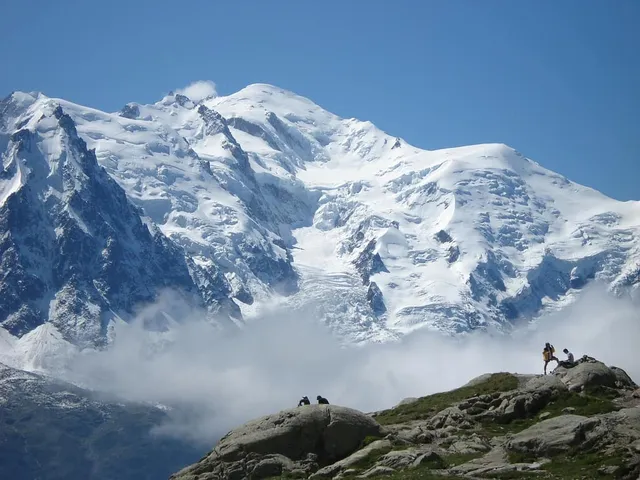
Ask which is the highest mountain in Europe and you will usually get one of two names. Most reference works say Mount Elbrus, a snow-covered volcano in southern Russia. Plenty of people, especially in Western Europe, will say Mont Blanc, the great white dome above Chamonix. Both answers have a logic to them, and the difference between them is not a measuring error. It is a line on a map.
The highest mountain in Europe is Mount Elbrus, at 5,642 m (18,510 ft), in the Caucasus Mountains of southern Russia just north of the Georgian border. That answer assumes the common convention that puts the Europe-Asia boundary along the crest of the Greater Caucasus. Mont Blanc, at roughly 4,806 m (15,770 ft), is the highest mountain in the Alps and in Western Europe.
What matters more than which name wins is how much changes when you move the border, and how far down the list Mont Blanc really sits if you accept Elbrus.
How tall is Mount Elbrus?
NASA’s Earth Observatory, captioning an astronaut photograph of the mountain taken from the International Space Station, describes Elbrus as the summit of the Caucasus and “Europe’s highest peak (5642 m)”. That figure is for the western summit. Elbrus is a double-headed volcano: its eastern summit is a little lower, at about 5,621 m (18,442 ft), and the two are joined by a broad snowy saddle.
Elbrus is an old volcano rather than a folded mountain. It has not erupted for roughly 2,000 years, according to the same NASA caption, which is why it has the smooth, rounded profile of a volcanic cone rather than the jagged rock towers of the surrounding range. Its eastern summit was first reached in 1829 and the higher western summit in 1874.
That shape is worth knowing if you are trying to spot it. In a range of sharp, heavily glaciated ridges, Elbrus stands out as a wide, two-humped white mass sitting slightly apart from the main crest, more like a giant snowfield lifted into the sky than a single spire.
Why the answer depends on where Europe ends
Continents are not separated by oceans everywhere, and between the Black Sea and the Caspian Sea the Europe-Asia boundary has to be drawn across land. Geographers have used two main lines.
The Greater Caucasus watershed. This draws the border along the main crest of the Caucasus, the line where water drains north on one side and south on the other. Most geographers in the Soviet Union favoured it, and it became the standard convention in the later twentieth century. Elbrus sits a short distance north of that crest, so under this line it is in Europe, and it is Europe’s highest mountain by more than 400 m.
The Kuma-Manych Depression. This older line runs across the lowlands well to the north of the mountains. It was the most commonly used boundary in Russia in the early twentieth century and is still mentioned as an alternative today. Under it, the whole Caucasus range, Elbrus included, falls in Asia, and the highest mountain left in Europe is Mont Blanc.
Neither line is “official” in any legal sense. There is no international body that rules on where a continent ends. That is why respectable sources can disagree and both be internally consistent. If you see Mont Blanc called the highest mountain in Europe, the writer is either using the older boundary or, more often, quietly meaning Western Europe or the Alps.
Where Mont Blanc really ranks
The less obvious consequence of the watershed convention is that Mont Blanc is not Europe’s second-highest mountain. It is not even close.
Elbrus is not a lone giant. The central Caucasus carries a whole cluster of summits above 5,000 m, among them Dykh-Tau, Shkhara (the highest point of Georgia, on the Georgia-Russia border) and Koshtan-Tau, all at around 5,150 to 5,200 m (roughly 16,900 to 17,100 ft). Published heights for these peaks vary by a few metres between sources, but the order of magnitude does not. On WorldAtlas’s list of the ten highest mountains in Europe, every entry is a Caucasus peak, and Mont Blanc does not make the top ten.
So the honest summary is:
- Highest in Europe (Caucasus counted): Elbrus, 5,642 m.
- Highest in Europe (Caucasus excluded): Mont Blanc, about 4,806 m.
- Highest in the Alps, Western Europe and the European Union: Mont Blanc (France and Italy still disagree over exactly where their border runs across the summit).
That third line is why Mont Blanc’s reputation is so secure. For most travellers in Europe it is the highest mountain they will ever see.
Mont Blanc’s moving number
Mont Blanc has one more complication: its height changes. The summit is a dome of snow and ice sitting on a lower rock top, and the snow cap thickens and thins with the weather. Surveyors from Haute-Savoie re-measure it every two years, and in 2023 they recorded 4,805.59 m (15,766 ft), more than 2 m lower than the previous survey. The full story, and why a few metres of snow make the official number move, is in Mont Blanc: why the roof of the Alps changes height.
None of those swings come anywhere near closing the gap to Elbrus. Even at its highest recorded figure, Mont Blanc is more than 800 m lower.
Why the question matters to climbers
The border question is not only academic. The Seven Summits, the challenge of climbing the highest mountain on each continent, has to choose a European summit, and almost everyone attempting it climbs Elbrus. The way the different lists handle that choice, and their other famous dispute over Oceania, is covered in the Seven Summits explained.
The same “which tallest do you mean” problem turns up elsewhere. In the United States the answer changes depending on whether you mean the whole country, the lower 48, or base-to-summit height, as laid out in what is the tallest mountain in the US.
Seeing them for yourself
Mont Blanc is by far the easier of the two to see. It is visible from Chamonix, from much of the Aosta Valley, and on clear days from Geneva and from high ground across the western Alps. The best places to stand are collected in the best places to see the Alps.
Elbrus is more remote. It is often hidden behind nearer ridges until you are in the valleys that lead up to it, and from a distance its broad double summit can be confused with lesser snowy tops. That is exactly the situation where naming a mountain by eye gets hard. If you find yourself in front of a big white skyline and are not sure which summit is which, point your camera at it and Mountain Identifier will name the peak, with its height and range.
The real peaks
Genuine photographs of the summits above — so you know what to actually look for: