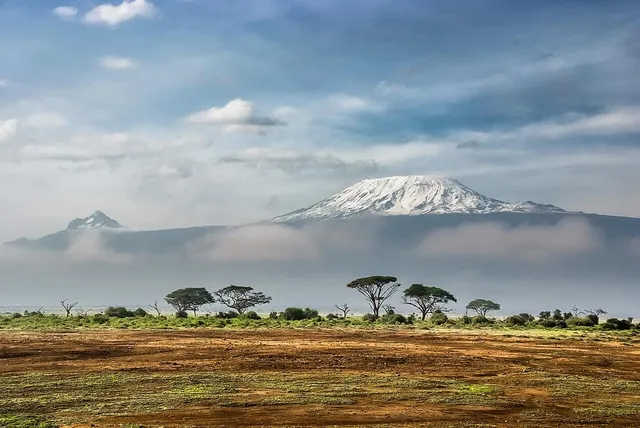
Africa’s highest mountain is one of the few famous summits nobody disputes. It is not hidden behind a ridge, and it does not share its top with a neighbour. It rises alone out of the savanna near the Kenyan border, and on a clear morning it dominates the southern horizon from the plains of Kenya.
The highest mountain in Africa is Mount Kilimanjaro, in northern Tanzania. Its summit, Uhuru Peak, on the crater rim of the Kibo cone, stands at 5,895 m (19,341 ft). It is also one of the most prominent mountains on Earth: almost its entire height rises from the surrounding plain, with no higher ground attached.
That settles the question. What follows is where the 5,895 m figure comes from, which mountains rank behind it (the answer depends on what you count as a separate mountain), and why its famous summit ice will not be there for much longer.
How tall is Kilimanjaro?
The official height, 5,895 m, is older than most people expect. It comes from a British survey in 1952 and has been quoted by Tanzanian authorities and reference works ever since. Later surveys have produced figures within a few metres of it, from about 5,892 to 5,902 m, but none has displaced it as the standard number.
Kilimanjaro is not one peak but three volcanic cones joined together:
- Kibo, the central cone, with Uhuru Peak on its crater rim at 5,895 m.
- Mawenzi, a jagged, eroded cone to the east, at about 5,149 m.
- Shira, the oldest and most worn-down, to the west, at about 4,005 m.
From a distance it reads as a single broad, flat-topped dome with a smaller rough summit off to one side. That second summit is Mawenzi, and it matters for the ranking below. Why such an enormous mountain can stand on its own, without a range around it, is the subject of Kilimanjaro, the free-standing giant.
What is the second highest mountain in Africa?
The second highest mountain in Africa is Mount Kenya, whose summit, Batian, reaches 5,199 m (17,057 ft). It is an old, deeply eroded volcano in central Kenya, and its spiky summit pinnacles look nothing like Kilimanjaro’s dome.
After that, the order depends on a choice. Mawenzi, Kilimanjaro’s second cone, is about 5,149 m high and rises roughly 850 m above the saddle connecting it to Kibo. On a list that treats any summit with 500 m of prominence as its own mountain, Mawenzi becomes Africa’s third-highest mountain. On a list that counts Kilimanjaro once, the third place goes to Mount Stanley in the Rwenzori. The idea of prominence behind that choice is the same one that makes the Seven Summits list argue with itself.
Here are Africa’s highest mountain massifs, counting Kilimanjaro, Mount Kenya and the Rwenzori once each (the Rwenzori has several more summits over 4,700 m, such as Mount Speke and Mount Baker):
| mountain | height | country | region |
|---|---|---|---|
| Kilimanjaro (Uhuru Peak) | 5,895 m (19,341 ft) | Tanzania | East Africa |
| Mount Kenya (Batian) | 5,199 m (17,057 ft) | Kenya | East Africa |
| Mount Stanley (Margherita Peak) | 5,109 m (16,762 ft) | DR Congo / Uganda | Rwenzori, Central Africa |
| Mount Meru | 4,566 m (14,980 ft) | Tanzania | East Africa |
| Ras Dashen | about 4,550 m (14,930 ft) | Ethiopia | Semien Mountains |
| Karisimbi | 4,507 m (14,787 ft) | DR Congo / Rwanda | Virunga Mountains |
Two notes on that table. Mount Meru, the highest mountain outside those three massifs, stands a short way west of Kilimanjaro, so the two are often seen together. And Ras Dashen’s height is less certain than the others: published figures for the Ethiopian Highlands are rougher, and the list it comes from warns that sources there can disagree by a wide margin.
The highest mountains in each part of Africa
Most of Africa’s highest ground is in the east, along the rift valleys. Other regions have their own high points, much lower but just as famous locally:
- North Africa: Jbel Toubkal, 4,167 m, in Morocco’s High Atlas. It is the highest mountain in North Africa.
- Africa’s Atlantic side: Mount Cameroon, an active volcano near the coast of Cameroon, about 4,040 m. Sources quote it slightly higher or lower.
- The Horn of Africa: Ras Dashen, about 4,550 m, in Ethiopia’s Semien Mountains.
Africa sits fourth among the continents by highest point, below Asia, South America and North America. For comparison, Europe’s highest mountain is covered in what is the highest mountain in Europe and South America’s in what is the highest mountain in South America.
Africa’s disappearing summit ice
Kilimanjaro, Mount Kenya and the Rwenzori are the only mountains in Africa that still carry glaciers, a remarkable fact for peaks so close to the equator. They will not keep them much longer.
On Kilimanjaro, NASA’s Earth Observatory reports that the mass of ice on the summit fell by more than 85 percent between 1912 and 2011. In 2012 a NASA glaciologist on the mountain reported that the northern ice field had split completely in two for the first time. Researchers point to more than one cause: warmer air plays a part, but so does a drier atmosphere that brings less fresh snow and fewer clouds to shade the ice.
The outlook for all three is similar. In its State of the Climate in Africa 2020 report, the World Meteorological Organization said that at current rates the glaciers of Kilimanjaro, Mount Kenya and the Rwenzori would be gone by the 2040s.
For anyone picking out Kilimanjaro on the horizon, the white crown is its most recognisable feature, and it is already much smaller than in older photographs. A Kilimanjaro with little or no ice will look like a different mountain, one more broad dark dome on the plain.
Telling Kilimanjaro from its neighbours
Kilimanjaro is easy to name once you know its outline: a long, gently curving summit dome, often with a band of cloud wrapped around its middle, and the broken teeth of Mawenzi off to one side. The confusion usually comes from Mount Meru, a steeper, more classic volcano cone to the west that can look taller from Arusha because it is so much closer.
If you are on safari or flying over northern Tanzania and not sure which summit is which, point your camera at the skyline. Mountain Identifier names the mountain and gives its height, prominence and distance from you.
The real peaks
Genuine photographs of the summits above — so you know what to actually look for: