
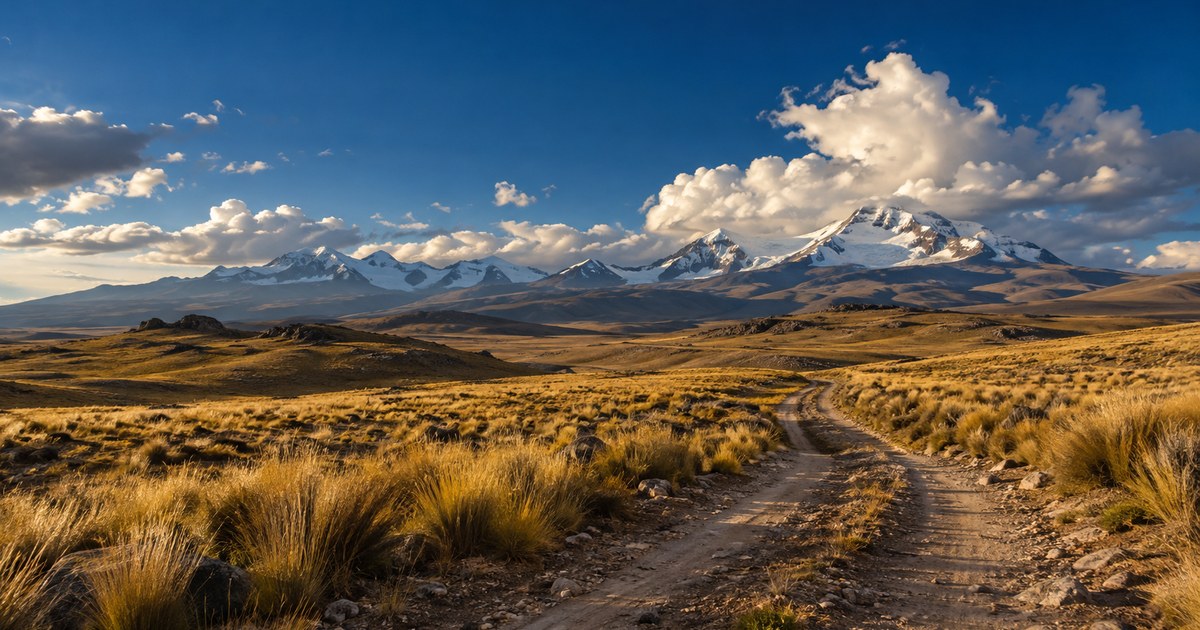
Mount Everest is the highest mountain on Earth, and nobody seriously disputes it. Yet if you could stand on the summit of Chimborazo, a glaciated volcano in the Ecuadorian Andes more than two and a half kilometres lower, you would be farther from the centre of the planet than any climber on Everest has ever been. Both statements are true, and the reason is that the Earth is not quite a sphere.
Chimborazo vs Everest comes down to what you measure from. Above sea level, Everest wins easily: 8,848.86 m (29,032 ft) against Chimborazo’s 6,263 m (20,549 ft). Measured from Earth’s centre, Chimborazo wins: its summit sits about 6,384.4 km from the centre, roughly 2 km farther out than Everest’s, because the planet bulges at the equator.
So which one is closest to space? That depends on how you define space.
How much does the Earth bulge?
The Earth spins, and the spin flattens it slightly into what geodesists call an oblate spheroid. NASA’s Earth fact sheet gives the equatorial radius as 6,378.137 km and the polar radius as 6,356.752 km. That is a difference of about 21.4 km between the distance from the centre to a point on the equator and the distance from the centre to either pole.
Sea level follows that bulge. So the sea-level surface you measure a mountain’s height from is itself farther from the centre near the equator than it is at higher latitudes. A mountain’s distance from the centre is therefore roughly “how far sea level is from the centre at that latitude, plus the mountain’s height above it”.
That is where the two mountains part ways. Chimborazo lies about one and a half degrees south of the equator, almost on top of the bulge. Everest lies at roughly 28 degrees north. Working from the NASA radii with a simple ellipsoid model, sea level at Everest’s latitude is something like 4.7 km closer to the centre than sea level at the equator. Everest’s 2.6 km height advantage over Chimborazo is not enough to make up that gap.
The measurements behind the claim
The claim is not just arithmetic. In February 2016 a French-Ecuadorian team, working as part of what was billed as the third French geodetic mission to Ecuador, took GPS measurements on the summit. As reported by the Ecuadorian newspaper El Universo, they put the summit at 6,384,415.98 m from the centre of the Earth, about 2 km farther out than Everest’s summit, which sits at roughly 6,382 km.
The US National Ocean Service, part of NOAA, gives the same conclusion in rounder terms: Chimborazo’s summit is “over 2,072 meters farther from the center of the Earth than Everest’s peak.” The exact margin you see quoted varies by a few dozen metres depending on the Earth model and heights used, but every serious calculation agrees on the order: Chimborazo first, by about 2 km.
Heights above sea level vary in the same way. Wikipedia, citing the February 2016 GPS survey, gives 6,263.47 m, while NOAA’s page and El Universo’s report give 6,268 m. That small disagreement is the same kind of datum-and-survey effect that gives many mountains more than one published height, explained in why do mountains have different elevations listed.
So which summit is closest to space?
Space does not begin at a fixed distance from the centre of the Earth. The most widely quoted boundary, the Kármán line, is defined by the FAI, the international air-sports record body, as an altitude of 100 km above mean sea level. By that definition, the edge of space follows the same bulge as the oceans, and the summit with the least air above it before you reach that line is the one highest above sea level: Everest.
So the precise answer is:
- Farthest point on Earth’s surface from the centre: Chimborazo.
- Highest point above sea level, and nearest to the conventional edge of space: Mount Everest.
“Closest to space” headlines about Chimborazo really mean “farthest from the centre”, which is a true and remarkable fact. It just isn’t the same thing as having less atmosphere overhead. If you climbed both, the air pressure on the summit of Everest would be markedly lower, because there is more air above Chimborazo’s summit.
Other ways to be “the tallest”
Chimborazo is one of several mountains that win a “tallest” title on a technicality, and each title answers a different question:
- Highest above sea level: Everest.
- Farthest from Earth’s centre: Chimborazo, with Peru’s Huascarán a very close second. Several other Andean peaks, and even Kilimanjaro, also beat Everest on this measure because they are so close to the equator.
- Tallest from base to summit: Mauna Kea, measured from the sea floor, covered in the tallest mountain base to summit.
- Most prominent: Everest, by a definition so special that it has no conventional prominence number, explained in why Everest has no prominence.
Prominence is a better guide than raw height to how much a mountain stands out from its neighbours, and Chimborazo scores well there too: its prominence is about 4,118 m (13,510 ft), the result of rising alone above the surrounding highlands. How those two numbers differ is laid out in elevation vs prominence.
Chimborazo’s other claim to fame
Chimborazo has a history of being called the highest mountain in the world. Before the nineteenth century it was widely believed to be the highest mountain on Earth above sea level, and in 1802 Alexander von Humboldt, with Aimé Bonpland and Carlos Montúfar, made an attempt on it that turned back at roughly 5,875 m. The first recorded ascent came in January 1880, by the English mountaineer Edward Whymper, who is better known for the first ascent of the Matterhorn.
Today the volcano is dormant, with its last eruption estimated at around AD 550. Its broad, glacier-capped dome stands isolated above the paramo grassland of central Ecuador, about 150 km south-southwest of Quito, which makes it one of the most distinctive shapes on the Andean skyline.
On a clear day Chimborazo is easy to recognise for exactly that reason: it is a single wide white mass rather than a jagged ridge. Telling it apart from its neighbours further away, like Cotopaxi’s steeper cone, is the kind of call where a second opinion helps. Point your camera at the skyline and Mountain Identifier will name the peak, with its height and prominence.
The real peaks
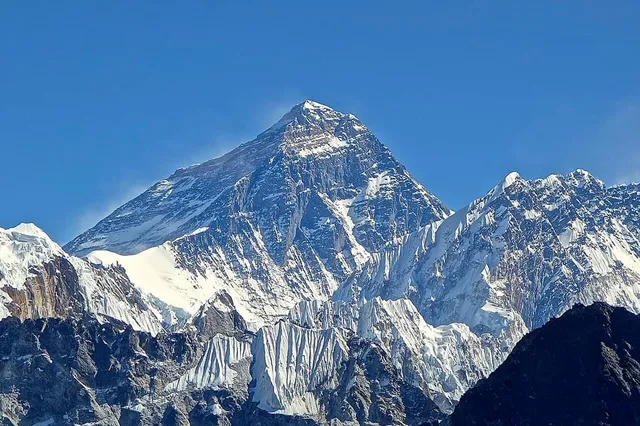
Genuine photographs of the summits above — so you know what to actually look for:
Sources
- What is the highest point on Earth as measured from Earth's center?, NOAA National Ocean Service
- Volcán Chimborazo le arrebata título al Everest (2016 French-Ecuadorian survey), El Universo
- Earth Fact Sheet (equatorial and polar radius), NASA Space Science Data Coordinated Archive
- Chimborazo, Wikipedia
- Kármán line, Wikipedia
- Mount Everest, Wikipedia