
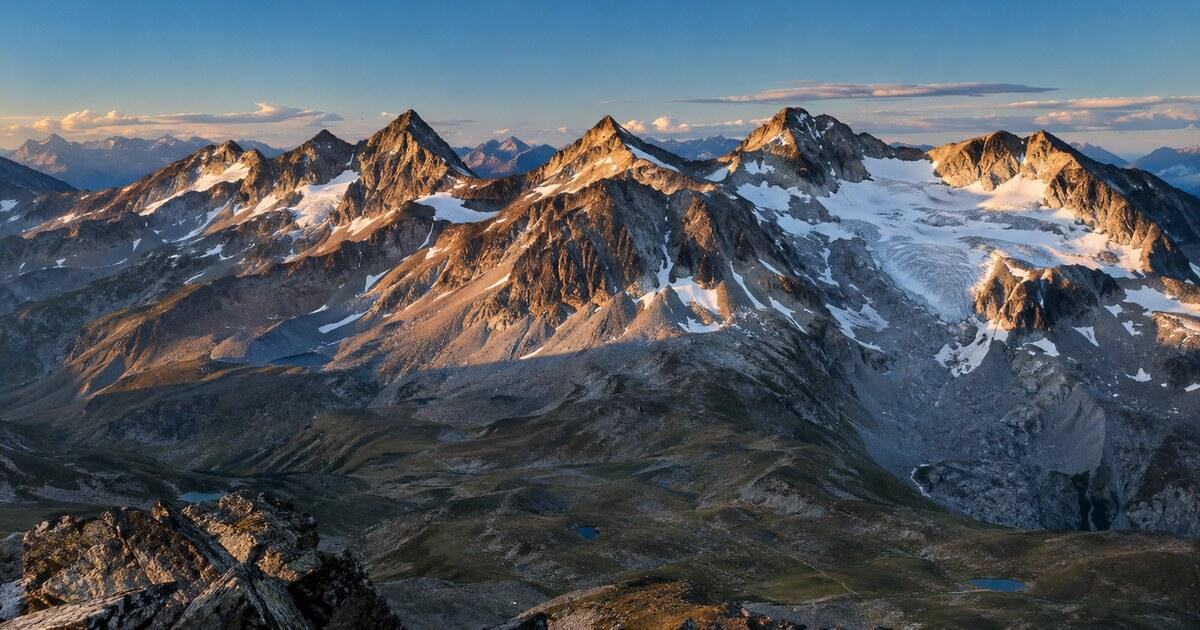
In Colorado, “14er” is not jargon. It is on bumper stickers, beer labels and trail signs, and plenty of people who have never worn crampons can tell you how many they have done. But ask what is a 14er, exactly, and how many there are, and the room splits in two. Half will say 53. The other half will say 58. Both are right, and the reason they disagree is one of the most useful ideas in mountain geography.
A 14er, or fourteener, is a mountain summit at least 14,000 ft (4,267 m) above sea level. Colorado has 53 of them under the usual rule that a summit must rise at least 300 ft (91 m) above the saddle linking it to a higher neighbour, and 58 if you also count five high points that fall short of that rule.
The rest of this piece explains that rule, the five summits it leaves out, and why the whole category rests on a round number in one particular unit.
What is a 14er, and who decides what counts?
The height part is easy. A fourteener is any summit whose elevation is 14,000 ft or more. In the United States the term is used for peaks in Colorado, California, Washington and Alaska, the only states that have them.
The hard part is the word “summit”. Mountains are lumpy. A big peak often has several bumps on its summit ridge, and a long ridge between two peaks will have high points along the way. If every bump over 14,000 ft counted, Colorado would have dozens more fourteeners, most of them indistinguishable rocks on the shoulders of real mountains. Some cutoff is needed to decide when a high point is its own mountain.
The cutoff most people use is prominence: how far a summit rises above the lowest point connecting it to higher ground. The convention commonly used by mountaineers in the contiguous United States sets that bar at 300 ft (91 m). A summit with at least 300 ft of prominence is “ranked” and counts as a separate fourteener. One with less is “unranked”, a sub-summit of something bigger. If prominence is new to you, elevation vs prominence covers it properly, and what makes a mountain vs a hill explains why every such cutoff is a convention rather than a law of nature.
How many 14ers are in Colorado: 53 or 58?
Apply the 300 ft rule and Colorado has 53 fourteeners, far more than any other state. Five more summits rise above 14,000 ft but do not clear the rule:
- Mount Cameron, about 14,238 ft, a broad high point between Mount Lincoln and Mount Democrat.
- El Diente Peak, about 14,159 ft, on the ridge running from Mount Wilson.
- Conundrum Peak, just over 14,040 ft on the higher of its two summit bumps, a northern sub-summit of Castle Peak.
- North Eolus, about 14,039 ft, the northern neighbour of Mount Eolus.
- North Maroon Peak, about 14,014 ft, the second summit of the Maroon Bells.
Add those five and you get 58, the figure many popular peak lists and guidebooks use, usually with the unranked peaks marked alongside the ranked ones. Many hikers count all 58, partly because several of the five, North Maroon and El Diente in particular, are serious climbs that look and feel like mountains in their own right. Others hold to 53 as the “official” number. Neither is wrong. They are answering different questions: one counts high points, the other counts independent mountains.
North Maroon is the best illustration. The Maroon Bells near Aspen look like twin peaks, and on a postcard they are two mountains. On the prominence rule, the northern bell rises too little above the saddle it shares with Maroon Peak to count on its own. What the eye reads as two mountains, the 300 ft rule reads as one mountain with two summits. That is exactly the situation our explainer on what a massif is deals with at larger scale.
How many 14ers are there in the US?
Using the same 300 ft rule, the United States has 96 fourteeners, per the standard list: Colorado 53, Alaska 29, California 12 and Washington 2.
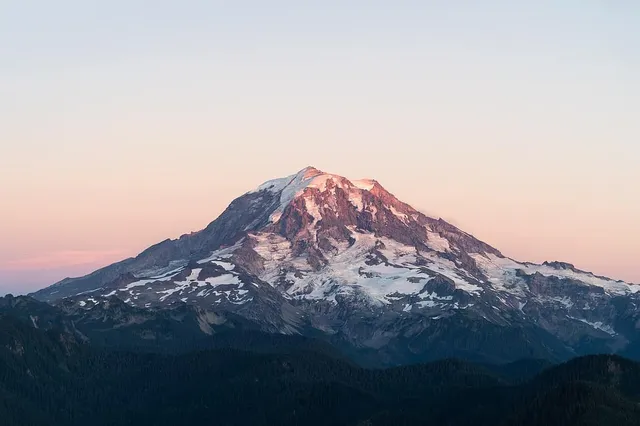
Washington’s pair is a neat case. Both of its ranked fourteeners are on Mount Rainier: the main summit and Liberty Cap, a subsidiary summit on the same volcano. Rainier’s main summit stands at 4,392 m (14,410 ft), according to the National Park Service, and the mountain is so large that one of its shoulders passes the prominence test on its own.
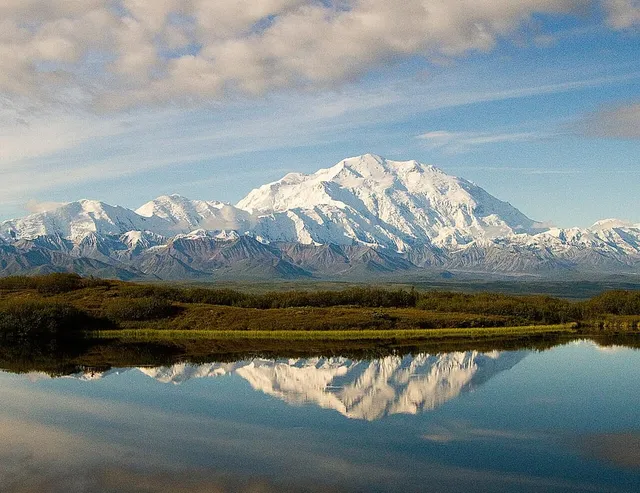
Alaska’s 29 are a different world. They include Denali and a string of giants in the Alaska Range and the Saint Elias Mountains that go far beyond 14,000 ft. In Alaska a fourteener is not a special category, just a mid-sized big mountain.
Why 14,000 feet? A round number in one unit
There is nothing geological about 14,000 ft. It is a round number in the unit Americans happen to use, and it converts to an unremarkable 4,267 m. Nothing changes in the rock, the air or the vegetation at that line.
Every mountain culture draws its own round-number line in its own units. The Alps have their four-thousanders, the summits above 4,000 m. Scotland has its Munros, the summits above 3,000 ft. Each list turns a continuous landscape into a countable collection, and each one immediately raises the same question Colorado faced: when is a high point a separate summit? The answers are always a mix of prominence rules and tradition.
Can the count change?
In principle, yes. Heights are measured against a reference surface for “sea level”, called a vertical datum, and when the datum changes, every height changes with it.
The National Geodetic Survey is preparing a new national datum, NAPGD2022, and its researchers have re-examined Colorado’s high summits, including the 1950s triangulation measurements behind many of their published heights. Their preliminary conclusion is that Colorado’s peaks will come down by roughly 1.6 m (about 5 ft). That raised an obvious question for a list defined by a line at 14,000 ft. The answer from the NGS is that all of Colorado’s fourteeners stay above it. The lowest ends up at about 14,004 ft.
Even “the lowest” is a moving target. Sunshine Peak in the San Juan Mountains has long held the title of Colorado’s lowest fourteener. The NGS’s preliminary table instead lists Huron Peak, in the Sawatch Range, as the lowest at 14,004.1 ft, with Sunshine a fraction of a foot above it. For peaks that close, the ranking depends on the survey.
The highest, at least, is not in doubt. Mount Elbert tops the list under every datum, as we covered in what is the highest mountain in Colorado.
Reading a skyline full of fourteeners
The practical lesson for anyone looking at mountains rather than climbing them is that “a fourteener” is a label on a list, not something you can see. In the Sawatch or the Front Range, a 14,000 ft summit and a 13,900 ft one side by side look identical, and a far-off unranked bump can outshine a ranked summit behind it.
If you want to know whether the summit in front of you makes the list, point your camera at it and the app will name it, with the elevation and the prominence that decide the question.
The real peaks
Genuine photographs of the summits above — so you know what to actually look for:
Sources
- Reevaluating the elevations of Colorado mountain summits — NOAA Institutional Repository
- Moving Mountains: NGS Researchers Reevaluate the Heights of Colorado Mountain Peaks — National Geodetic Survey, NOAA
- How Many Fourteeners Are In Colorado: 53 or 58? There's No Easy Answer — The Next Summit
- Mount Rainier National Park — National Park Service
- Fourteener — Wikipedia
- Sunshine Peak — Wikipedia
- Castle Peak (Colorado) — Wikipedia