Every continent has a highest point, but only one of them routinely vanishes. Ask a ranger how tall is Denali and you’ll get a precise answer; ask to actually see the mountain and you’ll get a weather forecast and a shrug. North America’s roof is both one of the most impressive summits on Earth and one of the hardest to lay eyes on.
Denali is 6,190 m (20,310 ft) tall, the highest mountain in North America. That figure comes from a 2015 GPS re-survey by the United States Geological Survey, which trimmed ten feet from the 20,320 ft value used since the early 1950s. Its prominence, 6,144 m (20,156 ft), ranks third among all mountains on Earth.
Those are the headline numbers. The story behind them — a re-measurement, two name changes, and a cloud problem — is what makes this peak worth knowing before you go looking for it.
How tall is Denali, exactly — and why the answer changed in 2015
For six decades the official answer was 20,320 ft (6,194 m), a figure produced with 1950s-era survey technology. In June 2015 a team of GPS specialists working with the USGS carried modern receivers to the summit, and that September the USGS announced the corrected height: 6,190 m (20,310 ft). The mountain hadn’t shrunk in any meaningful sense — the measurement had simply gotten better. Ten feet is nothing on a mountain this size, but it’s a useful reminder that every elevation you read is a measurement with a history, not a fact of nature. Good sources tell you which survey they’re quoting.
Even at the revised height, nothing else on the continent comes close. Denali stands alone at the top of North America’s list, high enough that its upper slopes create their own ferocious weather — a fact that matters later in this story.
The numbers that make it a giant: prominence, rise and isolation
Elevation is where Denali’s case starts, not where it ends. Its prominence — how far you’d have to descend before you could climb anything higher — is 6,144 m (20,156 ft), third on Earth behind Everest and Aconcagua. Its topographic isolation is about 7,440 km (4,620 mi): from Denali’s summit, the nearest terrain as high as you’re standing is on the other side of the Pacific.
And then there’s the statistic that regularly startles people: measured from its own base to its summit, Denali rises roughly 5,500 m (18,000 ft) above the surrounding lowlands — a greater base-to-peak rise on land than Everest, which starts from the already-high Tibetan Plateau. We unpack that comparison properly in the tallest mountain from base to peak, but the short version is that no mountain on land climbs farther out of its own landscape. That combination — huge elevation, huge prominence, nothing nearby to soften it — is why Denali makes every list of the world’s most recognizable mountains: when it’s visible, it doesn’t look like the biggest thing on the horizon, it looks like a mistake in the sky. Height alone is not the whole contest, though: Whitney, Rainier and Mauna Kea each win a different version of the tallest mountain in the US.
McKinley, Denali, McKinley: one mountain, two names, three switches
The Koyukon Athabascan people of interior Alaska have called the mountain Denali — usually glossed as “the tall one” or “the high one” — for far longer than any map has existed. The name Mount McKinley was attached in 1896 by a gold prospector, honoring William McKinley, an Ohio politician then running for president who never set foot in Alaska.
Alaska formally adopted Denali as the state name in 1975 and spent decades asking Washington to follow. In August 2015 — the same season as the height re-survey — the U.S. Department of the Interior restored Denali as the official federal name. Then in January 2025 a presidential executive order reversed course, and the Interior Department changed the federal name back to Mount McKinley — while the national park around it remains Denali National Park and Preserve, and Alaska’s official state name for the mountain remains Denali. Alaskans, polls and both of the state’s U.S. senators have been vocal that they intend to keep calling it what they’ve always called it.
So if you see both names on maps and in headlines, that’s not sloppiness; it’s a live naming dispute. In our peak guide and in the app we list it as Denali with Mount McKinley as an alternate name, so a search for either finds the same mountain.
Why most visitors never see it
Here is the cruel joke of North America’s highest peak: it is hidden more often than it is visible. Denali is so tall that it manufactures its own weather — moist air pushed up its flanks condenses into a semi-permanent shroud — and the surrounding Alaska Range catches storm systems rolling in from the Gulf of Alaska. By the commonly cited estimate, the mountain is socked in about two days out of three, and only around 30 percent of park visitors ever see the summit at all. Locals talk about joining “the 30 percent club,” and seeing the peak completely clear, top to bottom, is rarer still.
The practical advice writes itself. Give the mountain more than one day if seeing it matters to you. Early mornings are often kindest, before daytime heating builds cloud. And when it does appear — from the park road, from a Talkeetna flightseeing plane, or as a white wall on the horizon from Anchorage — don’t assume you’ll get a second chance.
There’s one more twist: because Denali is so much bigger than everything around it, first-time viewers sometimes refuse to believe they’re seeing it, assuming the huge pale mass above the cloud line must be more cloud. Point your camera at it and let the app settle the question — it will name the summit and hand you the elevation, prominence and range in one tap. If the answer comes back 6,190 m, congratulations: you’re in the club.
The real peaks
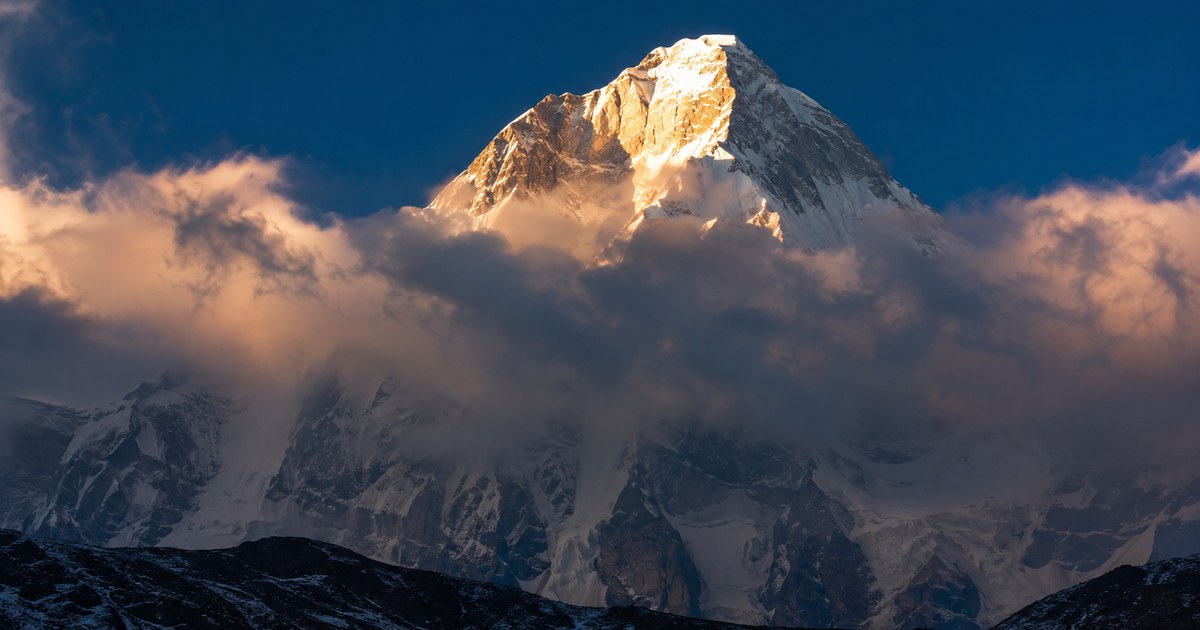
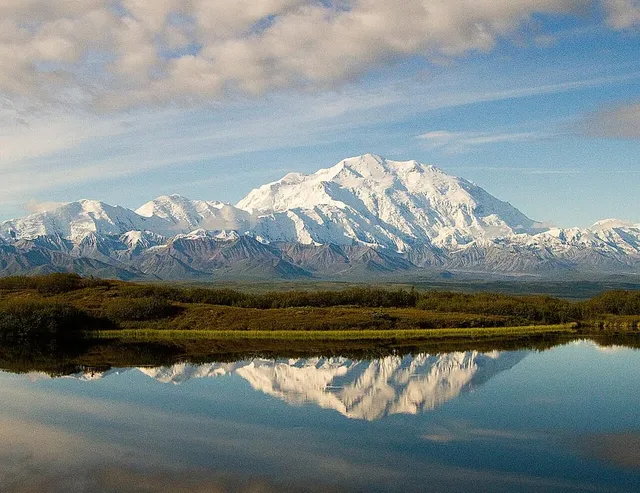
Genuine photographs of the summits above — so you know what to actually look for:
Sources
- Denali — Wikipedia
- North America's Tallest Mountain Gets New Name — and Height (AP/VOA)
- Denali Gets a New Name, Then Loses 10 Feet — NBC News
- Denali–Mount McKinley naming dispute — Wikipedia
- Why Is Viewing Denali So Elusive? Joining the 30% Club — Kantishna Roadhouse
- Denali, Not Everest, Is the Tallest Mountain on Land — SnowBrains
- Topographic isolation — Wikipedia