Some mountains you have to be told the name of. Others introduce themselves. This is a field guide to the twelve summits almost anyone can learn to spot on sight — what shape to look for, and where you’d have to stand to see it. Each links to our full guide with elevation, prominence and first-ascent details.
What makes a mountain recognizable at all?
Three things, mostly. Shape — a clean geometric form (cone, pyramid, table) that survives simplification into a logo or an emoji. Isolation — high prominence, so the peak owns its skyline instead of hiding in a crowd of neighbours. And a famous viewpoint — a city, lake or park from which millions of people have seen exactly the same angle, until that one silhouette becomes the mountain in everyone’s head. Everything on this list has at least two of the three.
One honest caveat before the tour: snow changes costumes with the seasons. Fuji without its snowcap in late summer fools people every year, and a spring-loaded Kilimanjaro looks very different from its lean October self. Shape and setting are the stable clues; snow is fashion.
The lone shapes
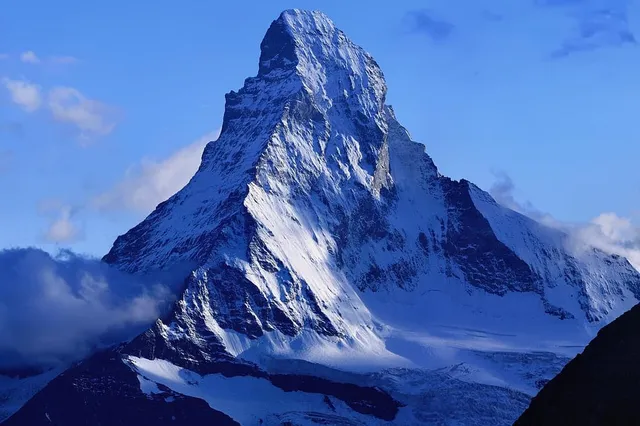
The Matterhorn (4,478 m, Switzerland/Italy) is the most recognizable silhouette in the Alps and possibly the world: a lone, slightly hooked rock pyramid whose four faces each point roughly toward a cardinal direction. From Zermatt, the crooked profile is unmistakable — no other Alpine peak looks remotely like it.
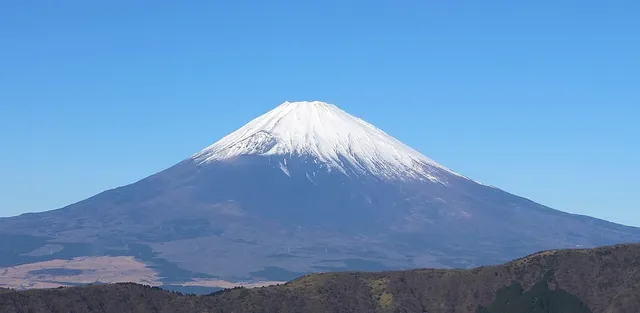
Mount Fuji (3,776 m, Japan) is the textbook volcanic cone: almost perfectly symmetric, snow-capped about five months a year, and visible on clear days from Tokyo and Yokohama, roughly 100 km away. If a mountain in Japan looks like a child’s drawing of a mountain, it’s Fuji.
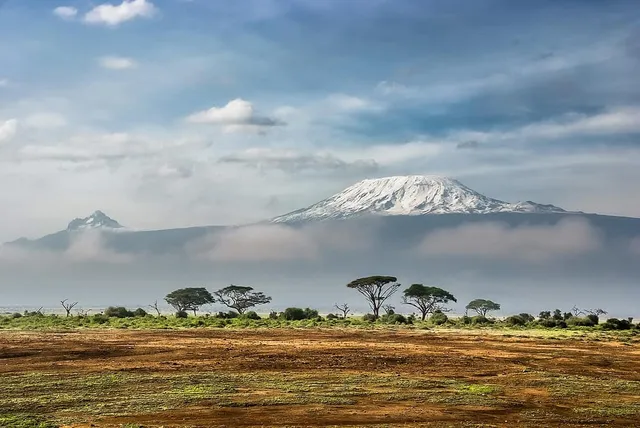
Kilimanjaro (5,895 m, Tanzania) is the world’s highest free-standing mountain — a vast, flat-topped, snow-capped massif rising straight out of the savanna with no neighbours at all. The classic view, elephants in the foreground, is from Amboseli National Park in Kenya.
Table Mountain (1,085 m, South Africa) proves you don’t need altitude to be iconic: a dead-flat sandstone plateau about 3 km across, flanked by Devil’s Peak and Lion’s Head above Cape Town, often wearing its “tablecloth” of cloud spilling over the edge.
The giants
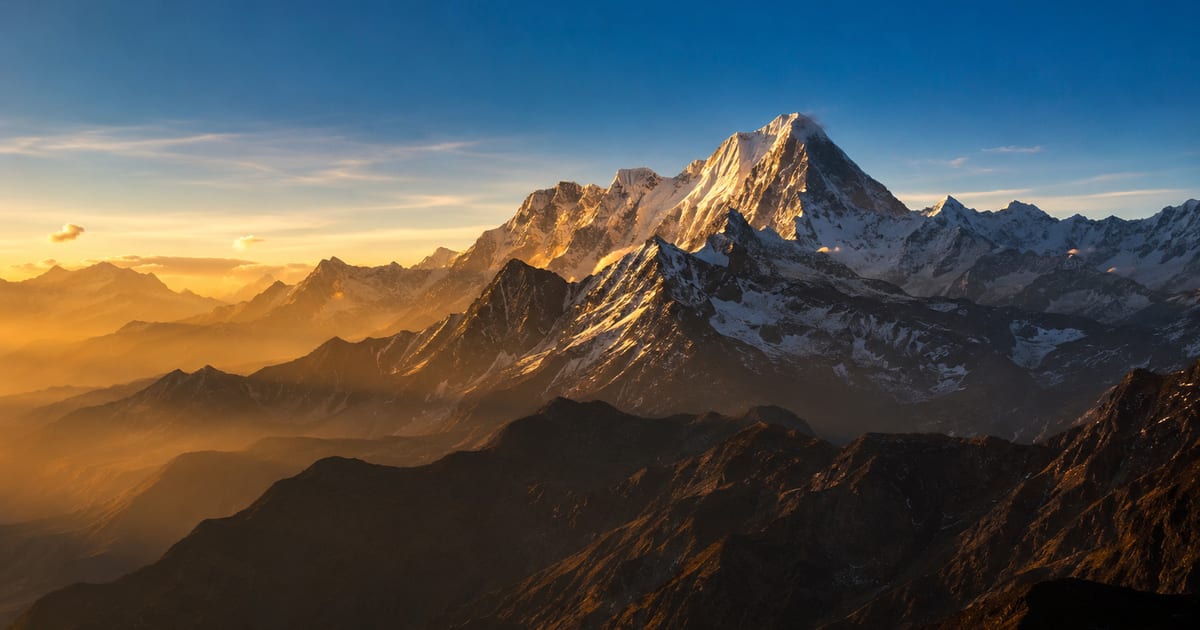
Mount Everest (8,848.86 m, Nepal/China) is, surprisingly, one of the harder ones to spot: from most Khumbu viewpoints it’s a dark pyramid with a snow plume peeking over the huge Nuptse–Lhotse wall. The classic trekker’s panorama is from Gokyo Ri.
K2 (8,611 m, Pakistan/China) is the recluse of this list — not visible from any settlement, only fleetingly glimpsed from the end of the Baltoro Glacier. When it does appear: a brutally steep, free-standing rock pyramid that explains its “Savage Mountain” reputation on sight.
Denali (6,190 m, Alaska) rises about 5,500 m from base to summit — by that measure the tallest mountain on land anywhere. Across Wonder Lake it reads as a wall of ice and granite that dwarfs the entire Alaska Range around it.
Aconcagua (6,967 m, Argentina) is the highest thing in the world outside Asia: a massive brown-and-white Andean giant towering over every summit near it, about 112 km from Mendoza.
The local landmarks
Mont Blanc (4,805.59 m, France/Italy) is a broad, rounded white dome — the name means exactly that — looming over Chamonix above a fence of jagged dark aiguilles. You identify it by the contrast: soft white crown, spiky surroundings.
Mount Rainier (4,391 m, Washington) is “the Mountain” of the Seattle–Tacoma skyline: a huge glacier-clad cone that appears to float above the city on clear days, visible from as far as Oregon and British Columbia.
Ben Nevis (1,345 m, Scotland) — the British Isles’ high point — hides its drama: from Fort William it’s a massive rounded bulk, with its famous 700 m cliffs tucked away on the hidden north face and the summit plateau frequently in cloud.
The Zugspitze (2,962 m, Germany/Austria) is Germany’s rooftop: a jagged limestone crest rather than a lone cone. The postcard angle is from the north, across the green water of the Eibsee.
Spotting them for real
Shape is the reliable clue — cone, pyramid, dome, table, crest — but light, snow cover and viewing angle change everything, which is why even famous peaks get misidentified from an unfamiliar side. Locals mix up Rainier and Adams from the wrong highway; trekkers photograph Nuptse believing it’s Everest; and every Alpine pass has a “Matterhorn” that isn’t. There’s no shame in it — mountains only look like their postcards from the postcard’s exact spot. When the skyline won’t give up its name, one photo settles it: the app matches the profile against its reference of named peaks and returns the best match with a confidence score, plus the elevation and prominence numbers explained in our guide to reading them.
The real peaks
Genuine photographs of the summits above — so you know what to actually look for: