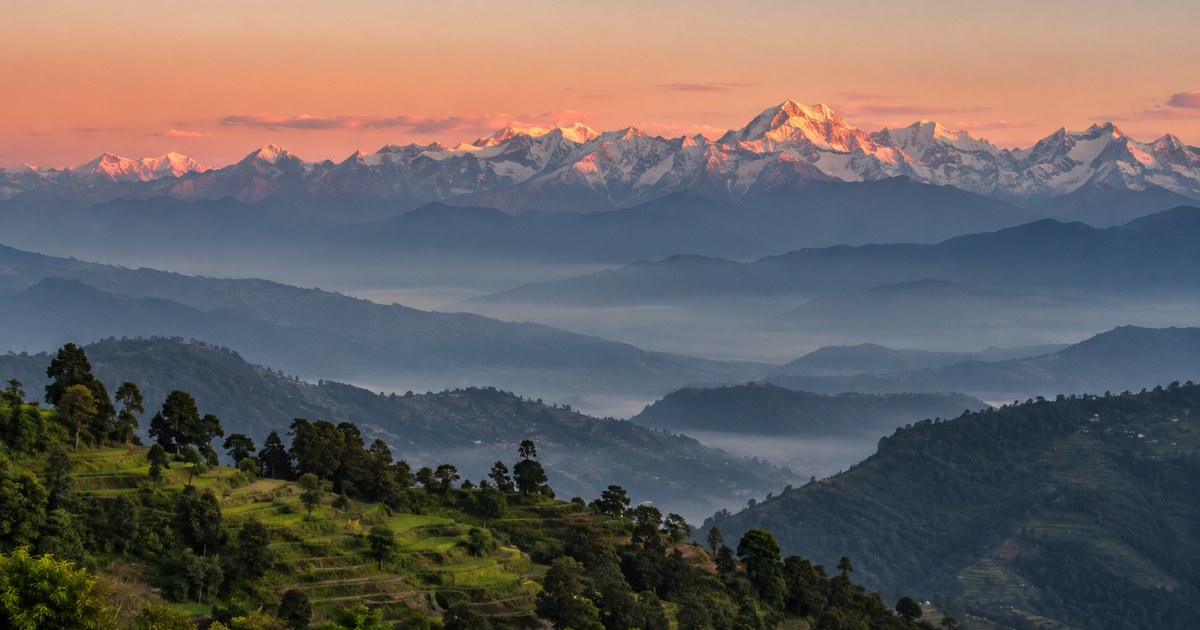
Almost everyone who flies into Nepal asks the same thing on the first clear morning: is one of those white peaks on the horizon Everest? Hotel rooftops advertise “Himalayan views”, tour operators sell sunrise trips to the valley rim, and it is easy to come away believing you saw the highest mountain on Earth from your breakfast table. So can you see Everest from Kathmandu? The honest answer is more interesting than yes or no.
Yes, but only just, and rarely. Mount Everest is about 165 km (100 mi) east-northeast of Kathmandu, and on exceptionally clear days its summit pyramid can be seen as a small tip above nearer ranges. On most days haze hides it, and the big white peaks people photograph from the city are other mountains.
Here is why, what you are probably looking at instead, and the places where you can see Everest properly.
Can you see Everest from Kathmandu itself?
The question was settled, as far as anything is, in the spring of 2020. With traffic and industry stopped by the pandemic lockdown, the air over the Kathmandu Valley cleared to a degree nobody had seen in years, and a Nepali photographer took a picture from Chobar, on the south-western edge of the valley, that appeared to show Everest. The mountaineer and writer Mark Horrell compared the photograph with Google Earth and other pictures of the range and concluded that the evidence points to Everest, about 165 km away; a reader’s reconstruction with a terrain-model panorama tool lined up the same way.
What the picture shows is also revealing. It is not the famous Everest of postcards, flanked by Lhotse and Nuptse. From Kathmandu the mountain is seen end on, with nearer peaks in the Rolwaling region blocking most of its neighbours, so what appears is a small snow pyramid along the south-east ridge, summit on one side and the South Summit on the other. You have to know exactly where to look to find it.
Distance is not the main obstacle. At Everest’s height, 8,848.86 m (29,032 ft), the curve of the Earth hides only a small fraction of the mountain at 165 km. The real obstacles are two. First, air: over that distance, even mild haze is enough to make a snow peak fade into the sky, and the valley’s normal smog is far more than mild. Second, terrain: most lines of sight from the valley floor hit a nearer ridge first. The geometry is covered in how far away can you see a mountain, and it shows why the answer is almost always the air, not the curve.
So “can you see Everest from Kathmandu” has a true answer of yes, and a useful answer of no. Do not plan a day around it.
Which peaks are you actually seeing from Kathmandu?
On a clear winter morning the northern horizon of the valley is lined with snow peaks, and none of the big ones is Everest. Horrell notes that the clear lockdown photos taken from Kathmandu mostly showed the Ganesh Himal, a range far closer than Everest to the north-west of the valley, and that on an ordinary hazy day even those peaks disappear. The nearest big snow peaks, the Ganesh and Langtang ranges to the north, always look larger than a mountain 165 km away.
This is a common mix-up, and a very natural one: the closest large white mountain always looks like the most important one. The same trap catches people all over the world, as we showed in the peaks everyone misidentifies.
Can you see Everest from Nagarkot?
Nagarkot, on the eastern rim of the valley, is the classic sunrise viewpoint, promoted by the Nepal Tourism Board for its panoramic mountain views, and it is widely sold as a place to see Everest. That is true only in the same sense as for Kathmandu. On the clearest mornings, usually in autumn or winter, Everest may be picked out far to the east, but at best it is a small, distant point behind a wall of closer mountains. The reason to go to Nagarkot is the whole panorama of the central and eastern Himalaya at dawn, not Everest specifically. If Everest is on your list, treat it as a bonus, and take binoculars.
Dhulikhel, further east along the highway toward Tibet, is sold on the same promise. The logic is the same: good height, a wide northern horizon, and Everest as a remote possibility on the clearest days.
Where can you actually see Everest?
If you want Everest as a mountain rather than a speck, you have three realistic options.
A mountain flight. Scenic flights leave Kathmandu’s airport early in the morning, fly east along the range for about an hour and turn back. Buddha Air’s “Everest Experience” is the best-known: every passenger gets a window, and the airline lists September to April as the best season. This is the only way to see Everest from Kathmandu in a single morning with a good chance of success. Ordinary airline flights along the Himalaya can show the range too, and we covered which side to sit on in mountains you can see from an airplane window.
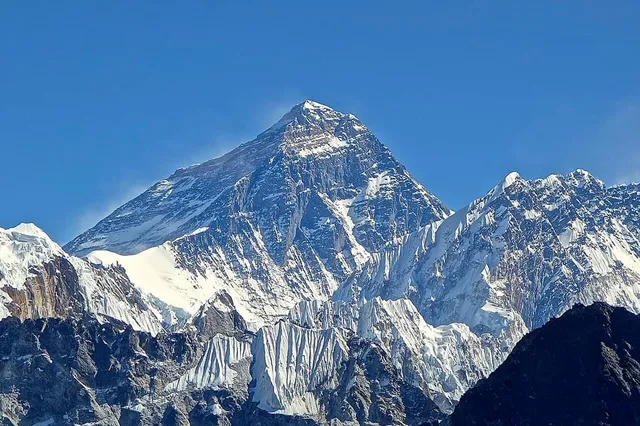
The Khumbu, on foot. The Everest region itself is protected as Sagarmatha National Park, a UNESCO World Heritage site. From Namche Bazaar and the hotels above it, Everest appears as a dark summit rising over the long Nuptse–Lhotse wall. The classic close-range viewpoints are Kala Patthar, a rocky high point above Gorak Shep at roughly 5,600 m (about 18,400 ft), and Gokyo Ri, above the Gokyo lakes, both of which give an open view of the summit pyramid. These are multi-day treks at high altitude, and planning them is a job for proper maps, local guides and current conditions, not a blog.
From Tibet. On the Chinese side, the road to the northern base camp gives the famous full-face view of the north side, with the summit rising above the Rongbuk Glacier. It is the most complete view of the mountain from the ground, and the logistics are a trip in their own right.
Why Everest is hard to see even up close
There is one more reason Everest disappoints first-time viewers, and it applies even in the Khumbu. Everest does not stand alone. It is the high point of a massif hemmed in by Lhotse and Nuptse, and from the south those two hide most of it. From some viewpoints its summit even looks lower than Nuptse’s nearer ridge, simply because Nuptse is closer. And because Everest has no higher neighbour to measure against, even its prominence is a special case, as why Everest has no prominence number explains.
The upshot is that seeing Everest well is less about getting close and more about getting the right angle on the right morning. If you are on a rooftop in Kathmandu, or at a rim village at dawn, looking at a line of white peaks and wondering which one is which, point your camera at the skyline and the app will name them, so you know whether that distant tip is the one you came for.
The real peaks
Genuine photographs of the summits above — so you know what to actually look for:
Sources
- Can you really see Mount Everest from Kathmandu? — Mark Horrell
- Nagarkot Sunrise and Sunset View — Nepal Tourism Board
- Everest, World's Highest Peak — Nepal Tourism Board
- Everest Experience: Mount Everest Sightseeing Flight — Buddha Air
- Sagarmatha National Park — UNESCO World Heritage Centre
- Mount Everest — Wikipedia
- Kala Patthar — Wikipedia