
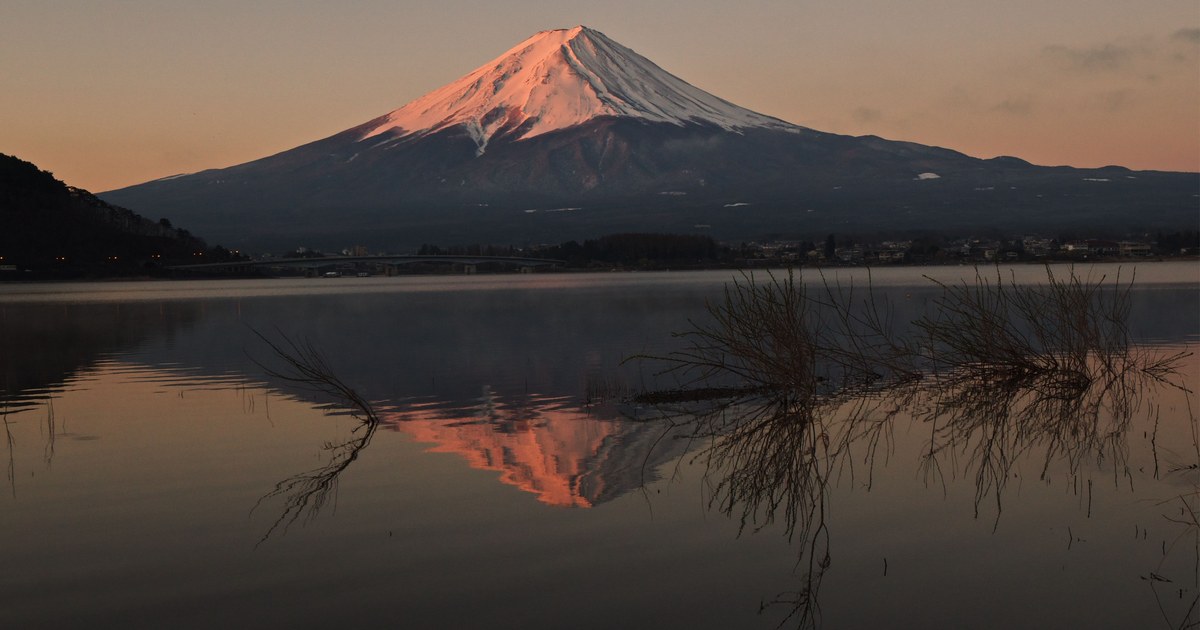
Every list of the best place to see Mount Fuji agrees on roughly the same spots: a pagoda above Fujiyoshida, the shores of Lake Kawaguchiko, Hakone, a seat on the bullet train. What the lists rarely say is how often any of those spots show you the mountain at all. Mount Fuji is a 3,776 m (12,389 ft) volcano that spends a large part of the year inside its own weather, and the most famous viewpoint in Japan is a view of cloud for weeks at a time.
The best place to see Mount Fuji is the Fuji Five Lakes area on its northern side, especially Lake Kawaguchiko and the Chureito Pagoda above Fujiyoshida, where the full cone rises directly over the water. But timing matters more than the spot: Fuji is clearest from November to February and most often hidden from June to August, with July the worst month.
So this guide starts with the calendar, then the places, then the two named effects photographers travel for.
When is Mount Fuji actually visible?
The best evidence comes from the city of Fuji in Shizuoka, which has logged the mountain every day since May 1990 from the eighth floor of its city hall, at 8 a.m., noon and 4 p.m., classing each look as fully visible, partly visible or not visible at all. The city also publishes a calendar built from more than three decades of those records, showing for every date of the year how often the mountain has been seen. The pattern is so consistent it should be the first line of every viewpoint guide.
Winter is the season. The dry, cold air that settles over the Pacific side of Japan from late autumn onward strips out the haze. In the city’s 2025 report, February led with 22 fully visible mornings, and January, November and December each logged 19. The rainy season and summer are the opposite. June to August are the city’s low months, and July is the worst of all in the long-run record, with the whole mountain visible on only about one morning in ten; in 2025 it managed five.
Two practical rules fall out of that record:
- Go early in the day. Cloud tends to build around the mountain as the ground warms, so a view that is perfect at dawn is often gone by lunch. Mornings are the better bet in every season.
- Snow is part of the package. In winter you also get the white cap that makes the cone read instantly on a skyline. In late summer the snow is largely gone and the mountain is a dark grey-brown cone that blends into the haze. How that white band moves through the year is covered in reading snow lines.
This is why a trip planned around a viewpoint so often disappoints and a trip planned around a season rarely does. If you can only go in summer, stay near the mountain for two or three nights and check at dawn, rather than making one long day trip and hoping.
The Fuji Five Lakes: the classic close-up
The five lakes (Kawaguchiko, Yamanakako, Saiko, Shojiko and Motosuko) sit in an arc along Fuji’s northern foot in Yamanashi Prefecture. They are the closest comfortable viewpoints to the mountain, close enough that the cone fills the frame without a long lens.
Chureito Pagoda, Fujiyoshida. The five-storied pagoda of the Arakura Sengen Shrine stands on a hillside above the town, reached by nearly 400 steps. It was built in 1963 as a peace memorial, and the composition from the terrace above it (red pagoda in the foreground, town below, Fuji behind) is one of the most reproduced views in the country. Arrive early; the terrace is small and the morning is when the mountain is most likely to be out.
Lake Kawaguchiko. The easiest of the lakes to reach from Tokyo, with the mountain across the water from the northern shore. It is where most first-time visitors see Fuji properly for the first time.
Lake Motosu. The westernmost and quietest of the five, and the source of an image that sat on Japan’s banknotes for decades. A photograph taken by Kōyō Okada near Nakanokura Pass on Motosu’s western side inspired the reverse of Japan’s former 1,000-yen and 5,000-yen notes, with the mountain reflected in the lake.
Lake Yamanakako. The largest of the five and the one best known for Diamond Fuji, described below.
Hakone and the Izu side: Fuji as a backdrop
Hakone, to the southeast, is the other name on every list, and it is a different kind of view. From Lake Ashi and the hills around it, Fuji rises behind a foreground of forested ridges rather than straight out of a lake at its foot. It looks further away because it is, and the intervening ridges can hide the lower slopes. What Hakone offers is combination: a day there works whether or not the mountain appears, which is not true of the lakes.
Further south, on the coast of Shizuoka, the pine-lined beach of Miho no Matsubara looks back at Fuji across Suruga Bay. It is one of the component sites of the UNESCO World Heritage listing for Fujisan, inscribed in 2013 as a sacred place and a source of artistic inspiration, and its view of the mountain across the sea has been painted and printed for centuries.
From the bullet train
The cheapest viewpoint in Japan is a window seat. On the Tokaido Shinkansen from Tokyo towards Osaka, Fuji appears on the right side of the train, which in an ordinary car means seat E. Coming back towards Tokyo it is on the left, seat A. The best stretch is around Shin-Fuji station, roughly 40 minutes to an hour out of Tokyo depending on the train, where the line runs across the flat coastal plain with nothing between you and the mountain.
It is a moving view and a brief one, but on a clear winter morning it is astonishing: the cone rises from almost sea level to 3,776 m with nothing to hide its lower flanks. From the city of Tokyo itself, the view is more distant and more conditional; we covered that separately in where to see Mount Fuji from Tokyo.
Diamond Fuji and upside-down Fuji
Two named effects have made particular viewpoints famous.
Diamond Fuji (Daiyamondo Fuji) is the moment the sun rises or sets exactly on the summit, so the peak appears to wear a jewel of light. Because the sun’s position changes through the year, each viewpoint gets its Diamond Fuji only on certain dates. Lake Yamanakako is the best-known site: the Yamanashi tourism office lists its Diamond Fuji season as running from mid-October to late February, and because it happens at sunset it suits anyone who would rather not get up before dawn. In calm conditions the sun and summit can also appear reflected in the lake.
Sakasa Fuji, upside-down Fuji, is simply the mountain’s reflection in still water. It needs a windless morning, which in practice means dawn at one of the lakes, and it is the reason photographers queue at the northern shores before sunrise.
Is that really Fuji?
It usually is, which is part of Fuji’s appeal: there is nothing else like it nearby. It stands alone, it is the tallest thing for a very long way, and its near-symmetrical cone is one of the most recognisable silhouettes on Earth, which is why it appears in our list of the most recognizable mountains.
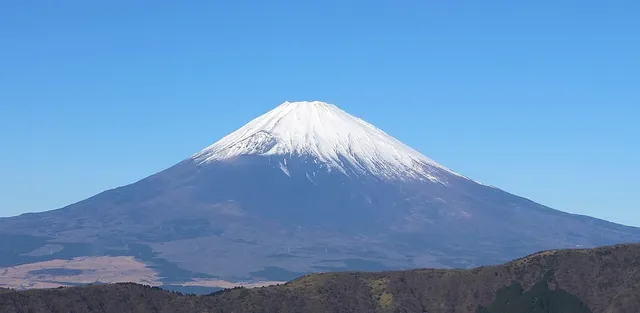
The cases where people get it wrong are at the edges of the season and the edges of visibility. On a hazy day the cone can fade until only the white summit shows, floating above the horizon with no visible base. The blue-grey wash that makes distant ridges hard to separate is explained in why mountains look blue. And from Hakone, where forested ridges stand in front of the view, a nearer summit can be taken for the mountain when Fuji itself is in cloud.
If you are standing at a lakeshore at dawn in December, you will not need help. If you are on a train window in May, looking at a pale shape through haze and wondering whether that is it, point your camera at it and the app will tell you, with its elevation and a confidence score.
The real peaks
Genuine photographs of the summits above — so you know what to actually look for:
Sources
- 富士山が見えた割合 (Share of days Mt. Fuji was visible) — Fuji City, Shizuoka
- 富士山観測の記録 (Mt. Fuji observation records) — Fuji City, Shizuoka
- 富士山観測の記録 令和7年報告 (2025 observation report, PDF) — Fuji City, Shizuoka
- Diamond Fuji (Lake Yamanakako) — Official Travel Guide Yamanashi
- Fujisan, sacred place and source of artistic inspiration — UNESCO World Heritage Centre
- Chureito Pagoda — japan-guide.com
- Mount Fuji from the Shinkansen: Which Side, Which Seat, and When to Look — JRPass.com
- Lake Motosu — Wikipedia
- Mount Fuji — Wikipedia