
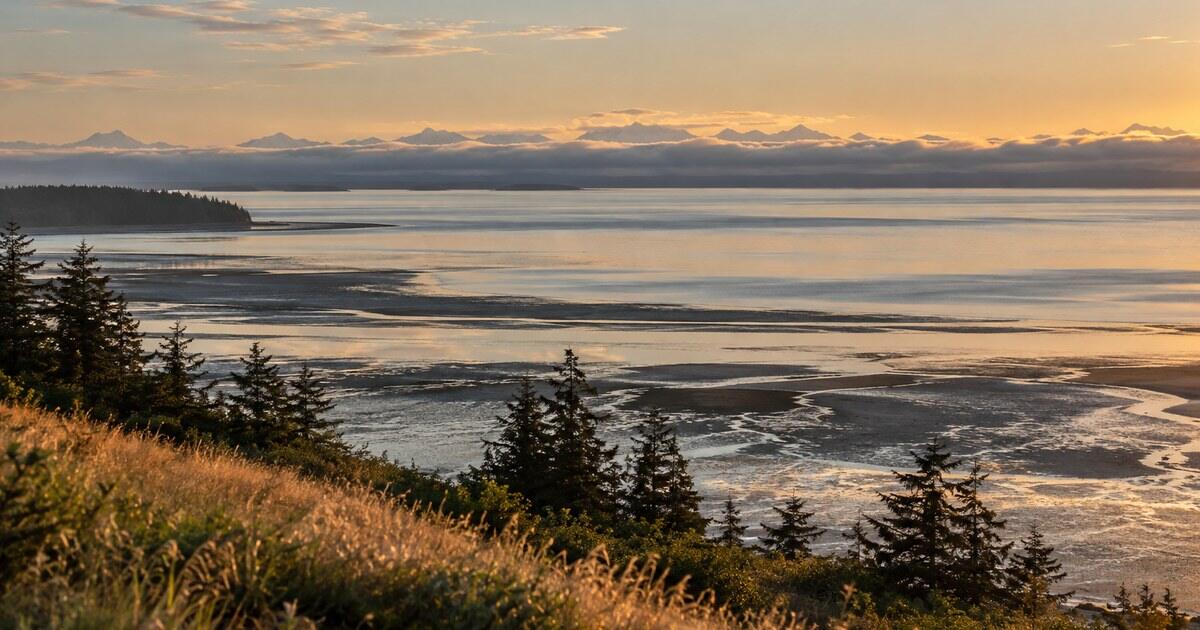
Anchorage is a city with mountains in its backyard. The Chugach rise straight up behind the eastern suburbs, close enough to watch the snow line move. But the mountain visitors really want is not in the backyard. It is far to the north, beyond Cook Inlet and a wide stretch of lowland, and the question is always the same: can you see Denali from Anchorage, or do you have to drive half a day north?
Yes, you can see Denali from Anchorage on a clear day. The summit is roughly 210 km (130 mi) north of the city, and it rises so far above everything around it that it clears the horizon easily. It appears as one of three big white peaks on the northern skyline, and it is the tallest of the three.
Where to stand, how to tell it from its neighbours, and how often it actually shows up are what decide whether you see it.
Can you see Denali from Anchorage, and how far away is it?
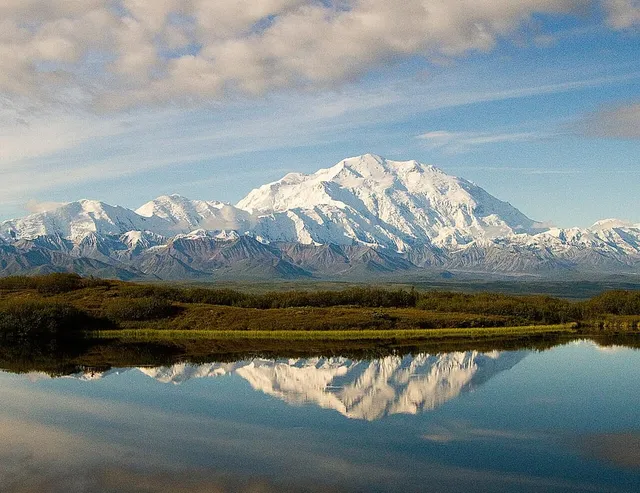
Denali, at 6,190 m (20,310 ft) after the 2015 survey, is the highest mountain in North America. Since January 2025 its federal name has once again been Mount McKinley, by presidential executive order; the national park and the State of Alaska still use Denali, and so do we. From Anchorage, it is a long way off: roughly 210 km (130 mi) in a straight line, and a drive of four to five hours by road, according to Visit Anchorage.
At that distance you might expect the Earth’s curve to hide it. It does not come close. A summit more than 6 km high can in principle be seen from several hundred kilometres away before the curve gets in the way. The limit in practice is the air: haze, smoke and cloud remove a peak long before geometry does. That trade-off is worked through in how far away can you see a mountain.
What also helps is that there is almost nothing in between. North of Anchorage, across Knik Arm, lies the broad, low Susitna valley. The Alaska Range stands at its far side with a clear sightline back to the city, so on a clear day the whole upper mountain shows, not just a tip. Visitors who expect a smudge are often surprised by how big it looks.
Which of the three white peaks is Denali?
This is the part most guides skip, and it is the part that trips people up. Denali does not stand alone on Anchorage’s horizon. Look slightly west of due north on a clear day and you will see three large white masses lined up together. ALASKA.ORG describes them well: three enormous white mounds like scoops of ice cream along the horizon.
From left to right:
- Mount Foraker, on the left (west), at about 5,304 m (17,400 ft), the third-highest summit in the United States.
- Mount Hunter, lower and set between the two, at about 4,442 m (14,573 ft).
- Denali, on the right, the biggest and highest of the three.
The trap is Foraker. It is a huge mountain in its own right, only about 900 m lower than Denali, and from Anchorage the two are far enough away that the difference in height is hard to judge by eye. On a hazy day, or when cloud hides one of them, it is easy to photograph Foraker and caption it Denali. The rule of thumb: if cloud leaves only one big white peak showing, check its bearing, because Foraker is the westernmost of the three. If you see a lower summit tucked between two giants, that is Hunter, and Denali is the one to its right.
The same “wrong giant” problem happens all over the world, but this is one of the cleanest examples, because all three peaks are among the highest in the country. For the national picture, see what is the tallest mountain in the US.
Closer to the city, don’t confuse the long, low ridge across Cook Inlet to the north-west with the Alaska Range. That is Mount Susitna, known locally as the Sleeping Lady for its reclining profile. It is a familiar Anchorage landmark and not part of the Denali view at all.
Where to see Denali in Anchorage
The best viewpoints share two things: a clear view north across open water or lowland, and a bit of height or a shoreline to get over the city.
- Point Woronzof. On the western edge of the city near the airport, looking across Knik Arm. ALASKA.ORG calls the view completely unobstructed, and it is the classic spot for the evening light.
- Earthquake Park. A little further east along the same shoreline, with a similar view and usually fewer people.
- The Tony Knowles Coastal Trail. The paved path along the coast links these areas, and stretches of it open onto the northern horizon.
- Kincaid Park. On the city’s south-western tip, with a little more height than the shoreline spots.
- Glen Alps and Flattop Mountain. In the Chugach foothills on the east side, high enough to look over the whole city toward the Alaska Range.
Wherever you stand, look slightly west of north, and look high. First-time viewers often scan the horizon line itself. Denali sits well above it.
How often can you see Denali?
Not as often as the postcards suggest. Denali is big enough to make its own weather, and cloud is the default. Lodges inside Denali National Park talk about the “30% club”, the commonly quoted idea that only about three in ten summer visitors to the park get a clear look at the mountain. From Anchorage, much further away, you have the mountain’s own clouds plus everything in the air between.
A few patterns improve the odds:
- Clear, cold, settled weather. A day when you can see the Chugach snow in sharp detail is a day worth checking the northern horizon.
- Morning and evening. Low sun lights the snow from the side, and cloud often builds over big mountains through the day. Evening light at Point Woronzof is the classic photograph.
- Watch for smoke. In wildfire season, smoke can hide the Alaska Range from Anchorage for days even when the sky overhead looks clear.
If you want Denali close up rather than on the horizon, the road north toward the park passes viewpoints much nearer the range, and the full story of why the mountain hides so often is in our profile of Denali, North America’s highest. For the wider picture of cities with a mountain on the skyline, Anchorage’s place among them is covered in which US cities have a mountain on the skyline.
When you are not sure which peak it is
On a hazy afternoon at Point Woronzof, with one big white shape showing through cloud, the honest answer to “is that Denali?” is often “maybe”. Direction helps. Relative position helps, if more than one peak is out. After that, it is a guess.
Point your camera at the peak instead and the app will name it, Denali, Foraker or Hunter, with its elevation, so you know which giant you are looking at before the cloud comes back.
The real peaks
Genuine photographs of the summits above — so you know what to actually look for:
Sources
- Mt. Denali Viewpoints: Where to See The Great One — ALASKA.ORG
- How far away is Denali? — Visit Anchorage
- Why Is Viewing Denali So Elusive? Joining the 30% Club — Kantishna Roadhouse
- North America's Tallest Mountain Gets New Name, and Height (AP via VOA News)
- List of mountain peaks of the United States — Wikipedia
- Mount Susitna — Wikipedia
- Denali–Mount McKinley naming dispute — Wikipedia