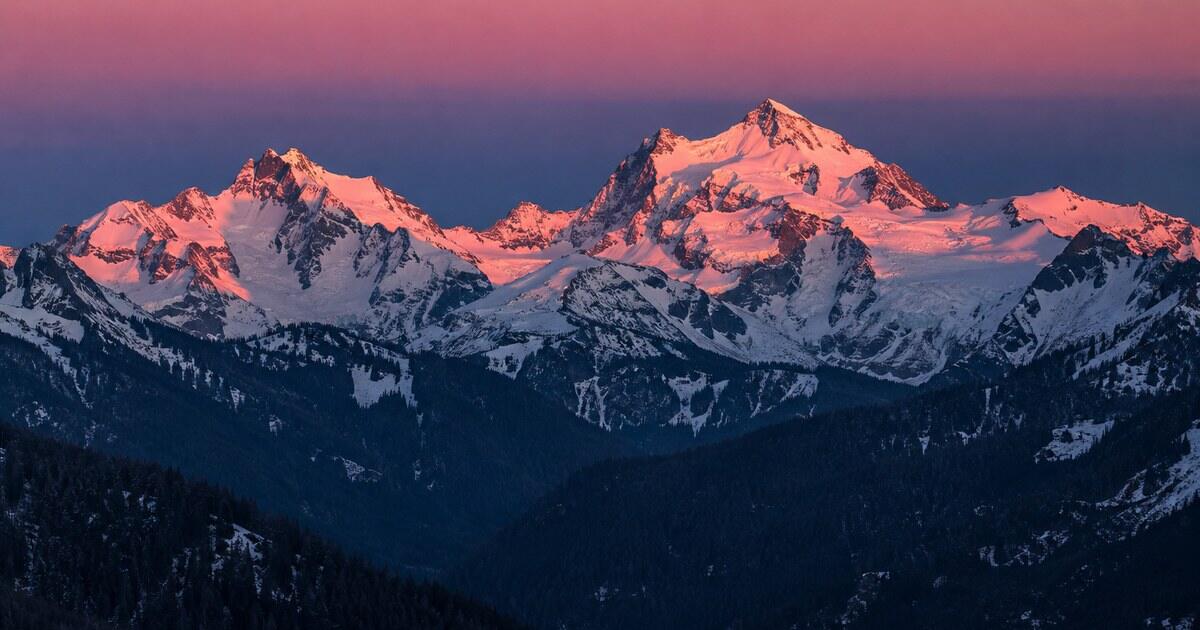
There is a moment at the end of a clear day in the mountains when the valleys have already gone grey, the sun has dropped out of sight, and the high summits suddenly turn pink. It lasts a few minutes, it photographs beautifully, and almost everyone who sees it asks what is alpenglow, exactly, and why it happens only to the peaks.
Alpenglow is the rosy or reddish glow on mountain summits around sunset and sunrise. Meteorologists use the word for a sequence: the peaks colour in the last low sunlight, fade, and then the colour briefly returns soon after sunset. In everyday use it covers any warm, low-angle light that turns high snow and rock pink.
That sequence is the key to the most useful thing alpenglow can do for you, which is to tell you which summit in a range is the highest.
What is alpenglow, strictly speaking?
The word comes from the German Alpenglühen, “Alps glow”. In the Dolomites the same effect goes by enrosadira, a name for the way the pale rock towers flush pink at dusk.
Definitions vary, and books and websites mix them freely.
The meteorologists’ definition. The American Meteorological Society’s Glossary of Meteorology defines alpenglow as the occasional reappearance of sunset colours on a mountaintop, usually snow-covered, soon after sunset, with a similar effect before sunrise. It describes the event in phases. First comes the ordinary colouring of the peaks by the low sun. Then the colour drains away. Then, for some minutes, it comes back, and in the glossary’s account this later stage, the afterglow, is lit by the purple light of twilight rather than by the sun itself. The glossary also notes that alpenglow seems to be much less common at sunrise than at sunset.
The everyday definition. In common use, including most photography, alpenglow simply means the vivid red-gold light of the last and first rays of the sun on high ground, with sharp shadows and strong colour. The Anchorage photographer Dan Bailey, who has watched the Chugach from the ground and from the air, argues that much of what people call alpenglow is direct sunlight still reaching high summits after the sun has set for everyone in the valley below. It is a matter of perspective: the sun has gone for you, not for the peak.
So when someone shows you a photo of a peak “in alpenglow”, it is usually that direct low-sun light. When a climber talks about the pink that comes back after the colour has drained away, that is the returning glow the meteorologists single out. Both are real; they happen a few minutes apart.
Why does the light turn pink?
The colour comes from the same physics that makes distant ridges look blue. Air scatters short, blue wavelengths far more strongly than long, red ones. When the sun is near the horizon, its light travels through a very long path of atmosphere to reach you or the mountain, and most of the blue is scattered out along the way. What arrives is orange and red.
Snow and pale rock are good reflectors, so they show that colour vividly. Dark forest and dark rock absorb it and stay dull, which is why the glow starts above the trees and why a mountain with fresh snow puts on a much better show than the same mountain in late summer. The other half of that physics, the blue haze that fills the air between you and a far ridge, is explained in why mountains look blue.
The pink band in the opposite sky: Earth’s shadow and the Belt of Venus
If you turn your back to the sunset on a clear evening, you will often see a related effect in the sky itself. Low above the eastern horizon there is a dark blue-grey band, and above it a pink one.
The dark band is the shadow of the Earth, cast onto the atmosphere. The pink band above it is the Belt of Venus, or antitwilight arch: air that is still lit by the reddened setting sun, scattering that light back toward you. NASA’s Astronomy Picture of the Day has run several photographs of it, from sunsets and sunrises alike. As the sun sinks, the Earth’s shadow rises and the pink belt rises with it before both fade.
The Belt of Venus and alpenglow are close relatives: both are lit by the reddened, low-angle light of twilight. One is that light on air, the other is that light on mountains. On a clear evening you can often watch the dark shadow line climb the eastern peaks while the pink belt sits just above their summits.
Reading a range with alpenglow
This is where alpenglow becomes a spotting tool.
At sunset the boundary between lit and unlit ground climbs every slope. It reaches the lower summits first and the highest last. So the last peak still catching direct colour is usually the highest one in view, and at sunrise the first peak to light up usually is too. On a range of similar-looking white summits, where you cannot judge height by eye, this is one of the few reliable clues you get for free.
Three caveats keep it honest:
- Distance and direction matter. A peak further west (at sunset) sees the sun a little longer, all else being equal, and a high ridge between a summit and the sun can put it in shadow early. The rule works best within one compact group of summits.
- Near peaks look bigger. A closer lower summit can loom over a farther higher one, even in alpenglow. Light tells you which one is lit, not which one is which.
- Snow exaggerates. A snow-covered summit glows brighter than a taller bare one, so brightness is not height. Watch for the last to stay lit, not the most vivid.
The glow also sharpens distance judgement. Lit summits stand out against a darkening sky with far more contrast than at midday, so ridges that blurred into one another in the afternoon haze often separate cleanly at dusk. Mountains far beyond your usual horizon can appear briefly as pink points; the limits on how far that goes are in how far away can you see a mountain.
When and where to see alpenglow
You need three things: a clear sky toward the sun, so light can reach the mountain; a clear sky between you and the mountain; and something pale for the light to land on. That means:
- Look east at sunset and west at sunrise. The peaks opposite the sun are the ones that glow.
- Choose snow-covered peaks. Late autumn to spring gives the best colour in most ranges, and the glow starts above the forest, where snow and bare rock take over. How the snow cover changes through the year is covered in reading snow lines, and where the forest stops in what is the tree line.
- Stay for the second act. If the direct colour fades to grey, wait. The returning glow the meteorologists describe sometimes comes back faintly a few minutes later.
Big isolated snow peaks are the classic subjects. Volcanoes such as Mount Rainier, rising alone from near sea level with a mantle of glacier ice, turn the colour of the sky above them on a clear evening, with nothing nearby to shade them.
If the pink summit in front of you is one you cannot name, point your camera at it before the light goes and the app will tell you which mountain it is, with the elevation that explains why it stayed lit.
Sources
- Challenging The Traditional Definition of Alpenglow — Dan Bailey Photography
- alpenglow — Glossary of Meteorology, American Meteorological Society
- afterglow — Glossary of Meteorology, American Meteorological Society
- Buck Moon and Belt of Venus (Astronomy Picture of the Day, 2026 August 1) — NASA
- Shadow Set (Astronomy Picture of the Day, 2006 February 4) — NASA
- Alpenglow — Wikipedia
- Belt of Venus — Wikipedia