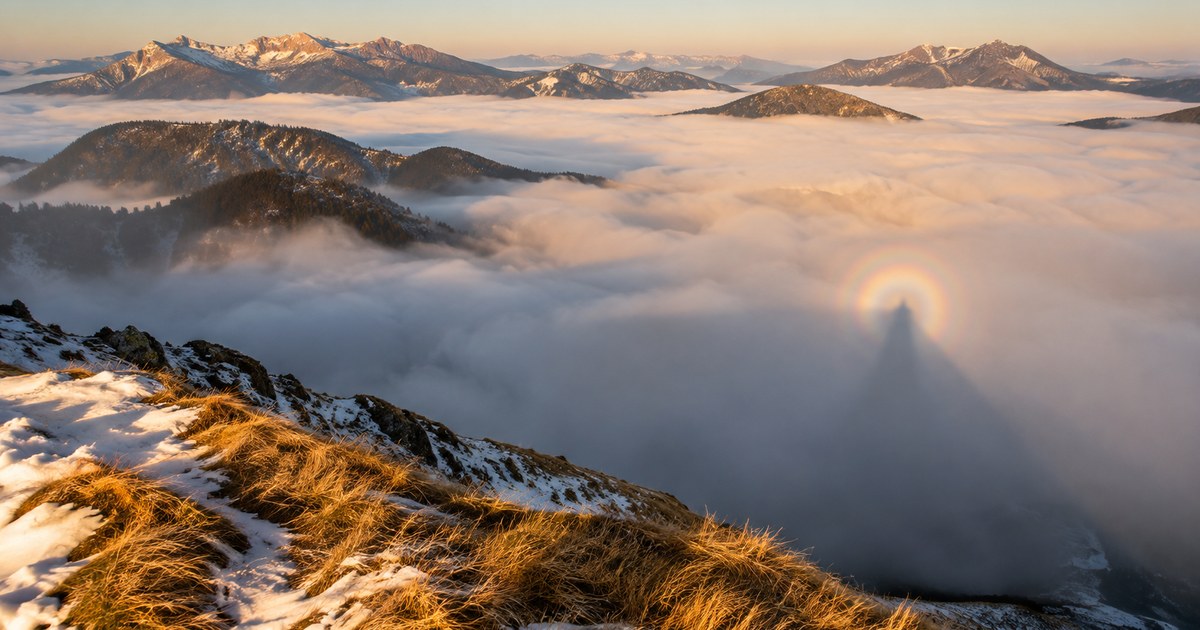
You reach a ridge above a layer of cloud, the sun low behind you, and a figure appears in the mist ahead: huge, grey, perfectly still when you are still, and moving when you move. Sometimes its head is wrapped in a ring of rainbow colours. For centuries walkers took it for a ghost. It is the most personal optical effect in the mountains, because the figure is you.
A Brocken spectre is your own shadow, cast by a low sun behind you onto mist or cloud in front of and below you. It looks enormous because the mist removes the cues your eyes use to judge distance and size. It is often surrounded by a glory, a set of coloured rings centred exactly on the shadow of your head.
The two parts, the giant shadow and the glowing rings, are separate effects that happen to appear together. Understanding each one tells you when to look for it, and why only you can see your own halo.
Where the name comes from
The Brocken is the highest peak in Germany’s Harz Mountains, at 1,141 m (3,743 ft). It is not a big mountain, but its weather behaves like that of a much higher one. Les Cowley’s Atmospheric Optics site describes an average temperature of only 2.9 °C and mist that wraps the summit for up to 300 days a year, which makes it close to an ideal stage for the effect.
The German natural scientist Johann Silberschlag described the phenomenon there in 1780, and the name stuck. The region’s folklore of witches and spirits did the rest. Today “Brocken spectre” is used for the effect anywhere it appears, and it is also called a mountain spectre or Brocken bow.
Why the shadow looks so big
The shadow itself is the simple part. With the sun low behind you, your shadow is thrown forward and lands on the nearest thing in front of you that can catch it: the droplets of a cloud bank or mist below your ridge.
The giant size is an illusion. In mist there are no familiar reference points. Your brain has no tree, rock or person nearby to compare the shadow against, and it tends to read the shadow as being as far away as the hazy landforms beyond it. Something that seems far away and still fills a big part of your view must be very large, so the shadow looks colossal. Les Cowley, quoted by EarthSky, suggests the glory helps the illusion along, together with the mist hiding more familiar reference points.
The shadow also has depth, which adds to the eerie effect. It is not painted on a flat screen but cast into a volume of droplets, so it can seem to shift, stretch and drift as the mist moves.
The glory: a halo that belongs to you
The coloured rings are the more remarkable part. A glory forms when sunlight enters tiny cloud droplets and is scattered almost directly back toward the sun. The precise physics is complicated enough that, as Cowley notes, it remains challenging to explain intuitively, but the result is simple to describe: a set of coloured rings around the point exactly opposite the sun.
That point is the antisolar point, and it always coincides with the shadow of your own head. So if you are standing on a ridge with a friend, each of you sees a glory around your own shadow’s head and not around the other’s. Your friend’s shadow is there, but it is the plain, haloless one. There is no way to share the view; every observer has their own.
The same geometry explains why the effect is so hard to stage. The sun has to be low enough to throw your shadow forward onto the cloud, and there has to be cloud below you in exactly the direction opposite the sun. That combination is common at sunrise and sunset on ridges that stand above valley fog or a cloud sea.
You have probably seen one from a plane
If you have never been on a misty ridge at the right moment, you may still have seen a glory. Air travellers see them often. EarthSky describes the setup: sit on the side of the aircraft away from the sun, look down at the cloud tops, and you may see the shadow of the plane racing across them with a small rainbow ring around it.
Because the glory is centred on the antisolar point, the ring sits around the part of the aircraft’s shadow where you are sitting. Move to the other end of the cabin and it moves with you. More about what you can see out of the window on a clear day is in the mountains you can see from a plane.
The glory that led to a Nobel Prize
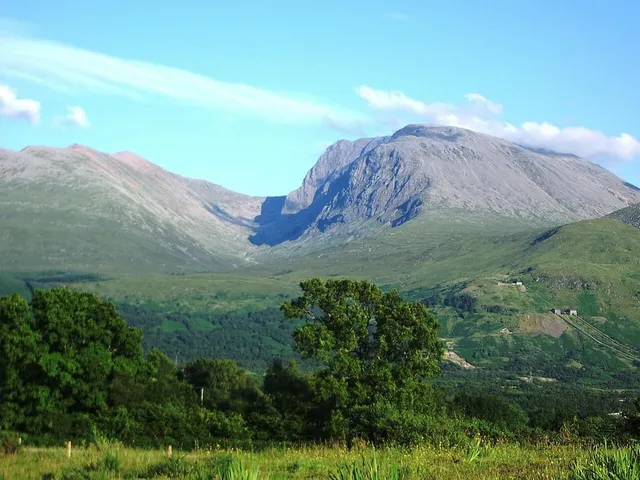
The Brocken spectre has a serious scientific legacy, and it starts on the highest mountain in Britain. In the late summer of 1894, the young Scottish physicist C.T.R. Wilson was working at the weather observatory on the summit of Ben Nevis. According to his Nobel Prize biography, he was struck by the beauty of the coronas and glories, “coloured rings surrounding shadows cast on mist and cloud”, and decided to recreate them in the laboratory.
His attempts to make artificial clouds at the Cavendish Laboratory in Cambridge led him in a different direction: he came to suspect that the drops were forming on ions, electrically charged particles in the air. That insight became the cloud chamber, the first instrument that made the tracks of individual subatomic particles visible, and it earned Wilson a share of the 1927 Nobel Prize in Physics. The University of Glasgow’s page on Wilson credits the Brocken spectre he saw from Ben Nevis’s summit as the sight that set him going.
When and where to look
The ingredients are the same everywhere:
- A low sun behind you, so early morning or late afternoon.
- Mist or cloud below or level with you, in front, on the side away from the sun.
- A vantage point above that cloud, such as a ridge, summit or viewpoint standing above valley fog.
Those are the same conditions that produce two other effects worth knowing about. A whole mountain’s shadow, rather than your own, can stretch away across the haze as a dark triangle, explained in why mountain shadows look like perfect triangles. And the summits still in sunlight around you may be glowing pink, which is alpenglow. Far ridges below will look blue for reasons laid out in why mountains look blue.
Mist that makes a spectre also hides the landscape. If you are in cloud on high ground, navigation is a job for a map, compass and GPS, not for optics. But when the cloud breaks and the peaks around you reappear, point your camera at them. Mountain Identifier will name each summit, with its height and distance.
The real peaks
Genuine photographs of the summits above — so you know what to actually look for: