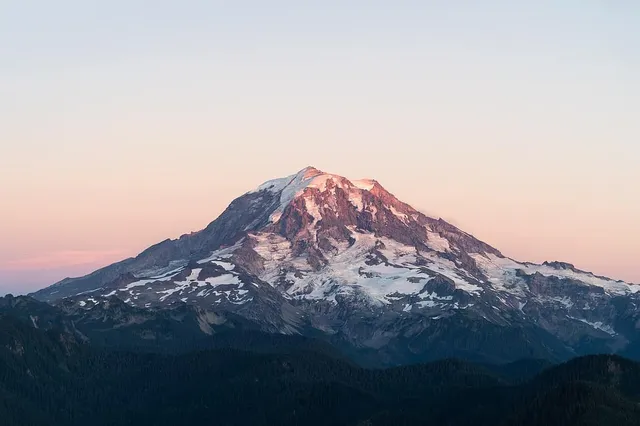
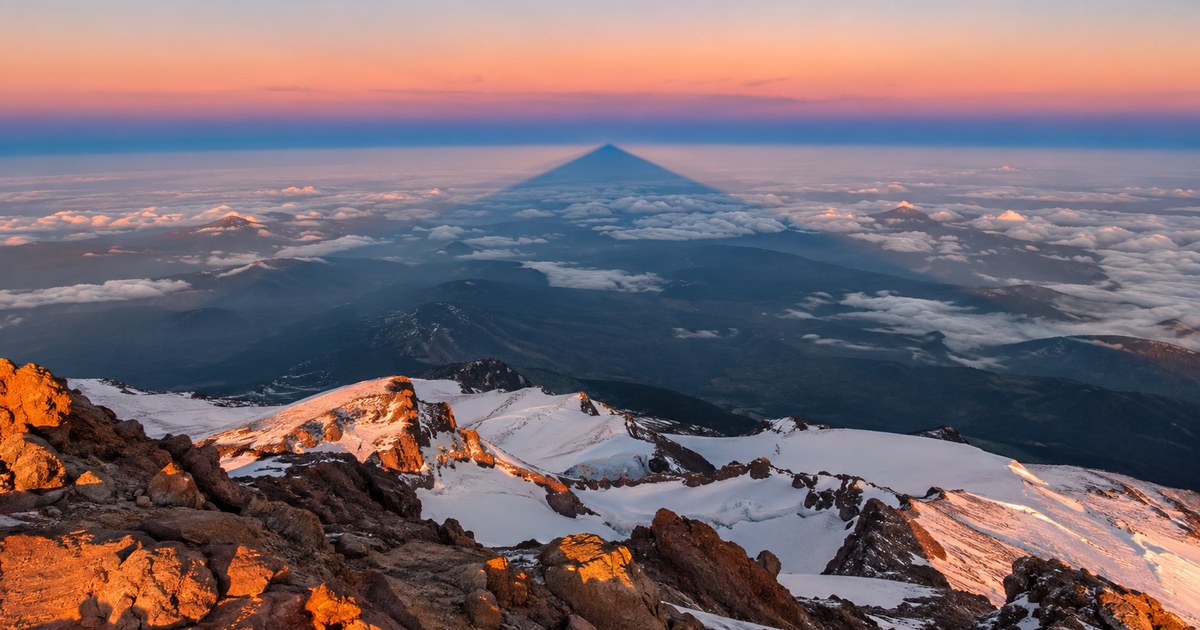
Stand on a high summit at sunrise, turn your back to the sun, and you will often see something that looks staged: a sharp, dark triangle laid across the landscape and the haze, its point reaching toward the horizon. It looks like the mountain has a perfect pyramid hidden inside it. It almost never does. The shape you are seeing has more to do with where you are standing than with the mountain.
A mountain shadow looks like a triangle because you are looking along it, not down on it. At sunrise and sunset the shadow is a long tunnel of shaded air stretching away from you toward the horizon, and like railway tracks its parallel sides appear to converge in the distance. Any large peak, rounded or pointed, casts this triangular-looking shadow to an observer on its summit.
That is the short version. The longer one explains why the effect needs a mountain rather than a tree, where the point of the triangle actually aims, and where you have a real chance of seeing it.
The railway-track effect
The cleanest explanation comes from NASA’s Astronomy Picture of the Day, which featured a famous photograph of the shadow of Mount Teide, the volcano on Tenerife in the Canary Islands. Teide is not a neat pyramid, yet its shadow at sunset looks like one. The caption points out that the observer is “looking down the long corridor” of a shadow that extends to the horizon, and that even a perfectly cube-shaped mountain would cast a shadow that appears to taper at the far end, “just as parallel train tracks do”.
Les Cowley’s Atmospheric Optics site describes the same thing from the summit’s point of view: you are standing at the top edge of a long tunnel of shadowed air and looking along its length. The cross-section of that tunnel matches the mountain’s real profile, but the far end is so distant that it shrinks almost to a point. What your eye reads as a triangle is a long, roughly mountain-shaped prism seen end-on.
This was worked out formally in 1979, when William Livingston and David Lynch published a paper on mountain shadow phenomena in the journal Applied Optics. Their abstract states that whether a mountain is flat-topped or pointed, all peaks cast triangular shadows to a summit observer when the sun is low. They also showed that the angle at the apex of the shadow depends only on the ratio of the mountain’s breadth to its height. A broad mountain throws a wide triangle; a narrow, tall one throws a slender spike.
Why trees and buildings don’t do it
If the triangle is just perspective, you might expect to see it behind every tall object at sunset. You don’t, and the reason is length.
The sun is not a point of light. Its disc is about half a degree across, so a shadow has a fully dark core that narrows with distance until it disappears. Cowley notes that triangular shadows are not seen from objects much smaller than mountains because their shadows are not long enough, and estimates that a high mountain’s dark shadow can run for roughly 320 to 480 km (200 to 300 miles). A building’s shadow fades out long before it can stretch to the horizon and show the converging-tracks effect. A big mountain’s shadow does not.
The other ingredient is air you can see. A shadow only shows up where there is something for it to fall on: lower ground, a cloud deck, or simply haze. On a perfectly clear day the part of the shadow that runs out across empty sky is faint; a little haze or a layer of cloud below the summit makes it bold.
Where the point of the triangle aims
The apex of the shadow sits in a very specific place. It points toward the antisolar point, the spot in the sky exactly opposite the sun. In October 2016, APOD featured a photograph taken near the summit of Mauna Kea in Hawaii at sunset, with a full Moon rising inside the mountain’s shadow. Its caption notes that the antisolar point lies near the vanishing point at the shadow’s peak.
The Moon in that picture is not eclipsed, which surprises people. The mountain’s shadow is a shadow in our own atmosphere; the Moon is hundreds of thousands of kilometres beyond it, lit by sunlight that the mountain has no way of blocking. It just happens to sit, from the photographer’s point of view, inside the dark wedge.
This gives the shadow a practical use. Because it always points directly away from the sun, the line of a summit shadow at sunrise runs roughly west, and at sunset roughly east, varying with the season. If you are on a viewpoint trying to work out which way a confusing skyline faces, the shadow gives a rough direction cue for orienting the view, though never a substitute for a map, compass or GPS when it comes to finding your way.
When the shadow looks like the mountain again
The triangle only appears when you look along the shadow. Step out to the side, onto a neighbouring summit or an aircraft flying past, and the same shadow looks quite different: a long dark band whose edge carries the real profile of the mountain, ridges and shoulders included. In that view a twin-summited volcano casts a twin-humped shadow, and a flat-topped mountain a flat-topped one.
That is the same lesson that runs through every attempt to name a peak by eye: shape depends on the angle you see it from. A mountain that is a perfect cone from one valley can be a lopsided ridge from the next, and the general guide to reading silhouettes is in how to identify a mountain by its shape. Shadows are the extreme case: from the summit, every mountain becomes a pyramid.
Where you can see a triangular mountain shadow
The ingredients are a large, high summit standing well above its surroundings, a low sun behind you, and some haze or cloud on the far side. That is why the best-known examples are big, isolated volcanoes and high peaks:
- Mount Teide, Tenerife. The subject of the classic NASA photograph, taken at sunset with the volcano’s shadow reaching toward the horizon.
- Mauna Kea, Hawaii. A high, isolated volcano whose sunset shadow NASA has featured with a full Moon rising inside it.
- Mount Rainier, Washington. Atmospheric Optics shows a photograph taken from Rainier’s summit at sunset in August 1978, with the mountain casting what looks like a triangular shadow onto the sky.
Large peaks in the Himalaya and the Andes produce the same effect, but any mountain big enough to stand clear of its neighbours will do it. You do not need to be on the very top, only high enough that the shadow has room to run out below you. How far that shadow can reach before the curve of the Earth and the haze swallow it is closely related to how far you can see from a summit, which is covered in how far away can you see a mountain.
The colours around the shadow
The triangle rarely arrives alone. At the same moment that it stretches out from the summit, the peaks around you that are still in sunlight turn pink and orange, and just above the opposite horizon a band of rosy light sits on top of the bluish shadow of the Earth itself. The pink light on summits is explained in what is alpenglow, and the hazy blue of the distant ridges below you in why mountains look blue.
If you are watching that scene from a viewpoint and want to know which of the glowing summits is which, point your camera at the skyline. Mountain Identifier will name each peak, with its height and distance, while the light lasts.
The real peaks
Genuine photographs of the summits above — so you know what to actually look for: