Seven men stood on the summit of the Matterhorn on 14 July 1865 — the last great unclimbed peak of the Alps, beaten at last. Within hours, four of them were dead on the glacier below, and the first ascent of the Matterhorn had become the most famous disaster in mountaineering history.
The first ascent of the Matterhorn was made on 14 July 1865 by a seven-man party led by Edward Whymper, climbing the Hörnli ridge from Zermatt. On the descent, Douglas Hadow slipped, dragging three companions with him; the rope linking them to the rest broke, and Croz, Hadow, Hudson, and Douglas fell to their deaths.
That one paragraph carries an entire era’s turning point. Here is the fuller story — and why it’s the reason you recognize this mountain on sight today.
The last great problem of the Alps
By 1865 the Alps had been swept almost clean. The “golden age of alpinism” — the frantic decade of first ascents generally dated from Alfred Wills’s 1854 climb of the Wetterhorn — had seen Britain’s gentleman climbers and their Alpine guides claim summit after summit. The Matterhorn, 4,478 m (14,692 ft) of freestanding rock on the Swiss–Italian border, was the great refusal: so steep on every side that many believed it simply could not be climbed.
Edward Whymper, a young English illustrator, had already thrown himself at the mountain repeatedly — mostly from the Italian side, often alongside Jean-Antoine Carrel, the Valtournenche guide who considered the peak his own. In July 1865 the rivalry came to a head: Carrel committed to an Italian attempt via the Lion ridge, and Whymper, hurrying to get ahead of him, assembled a party in Zermatt to try the Swiss side instead.
The team was a hasty coalition of two roped parties’ worth of ambition: Whymper; the celebrated Chamonix guide Michel Croz; Zermatt guide Peter Taugwalder and his son of the same name; the Reverend Charles Hudson, one of the strongest amateur climbers of the age; Lord Francis Douglas; and Douglas Hadow, a nineteen-year-old with almost no alpine experience — included, fatefully, on Hudson’s assurance.
The first ascent of the Matterhorn: 14 July 1865
The irony of the Hörnli ridge is that the mountain’s terrifying appearance from Zermatt conceals relatively moderate climbing. The party made rapid progress, and in the early afternoon of 14 July the ridge lay back and the summit was theirs — Croz and Whymper racing the last stretch. Far below on the Italian side they spotted Carrel’s party, still well short of the top. The Matterhorn was climbed, and it had been climbed from Switzerland.
They spent about an hour on the summit. Then the descent began, the party roped together in a single chain, Croz leading down, Hadow above him, then Hudson, Douglas, the elder Taugwalder, Whymper, and the younger Taugwalder.
On the steep upper section above the north face, Hadow slipped and knocked Croz off his stance. Hudson and Douglas were plucked off in turn. The rope snapped taut between Douglas and old Peter Taugwalder — and broke. Whymper and the two Taugwalders, clinging on, watched the other four slide and then fall roughly 1,200 m (about 4,000 ft) down the north face to the Matterhorn Glacier. Croz, Hadow, and Hudson’s bodies were later recovered; of Lord Francis Douglas, little was ever found.
The rope that failed became infamous: it was the weakest line the party carried, an older and thinner rope that should never have joined those two men. An official inquiry in Zermatt cleared the surviving guides, but rumor pursued the elder Taugwalder for the rest of his life, and Whymper’s own account in Scrambles Amongst the Alps fixed the tragedy permanently in the public imagination. Three days later, on 17 July 1865, Carrel and Jean-Baptiste Bich completed the Italian ascent by the Lion ridge — a magnificent climb remembered by almost nobody outside Italy.
The end of the golden age
Historians conventionally close the golden age of alpinism with this climb. Partly that’s bookkeeping — with the Matterhorn gone, no comparable “last great problem” remained in the Alps. But mostly it was the shock. Four men, two of them aristocratic and one a famous clergyman-climber, had died in the very hour of the sport’s greatest triumph. The British press erupted; even Queen Victoria is reported to have asked whether mountain climbing could be discouraged. Climbing continued, of course — but the age of innocent conquest was over, replaced by an era that took death seriously.
The disaster did something else, too: it made the Matterhorn the most famous mountain in the world. The story sold newspapers, then books, then paintings and posters, and tourists came to Zermatt specifically to stand beneath the peak that had exacted such a price.
Why you picture the Hörnli ridge
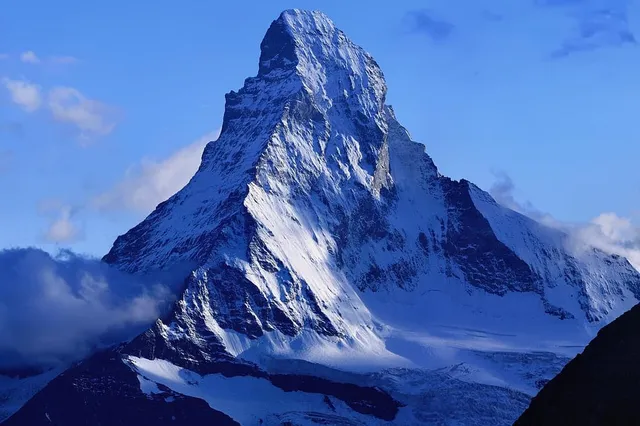
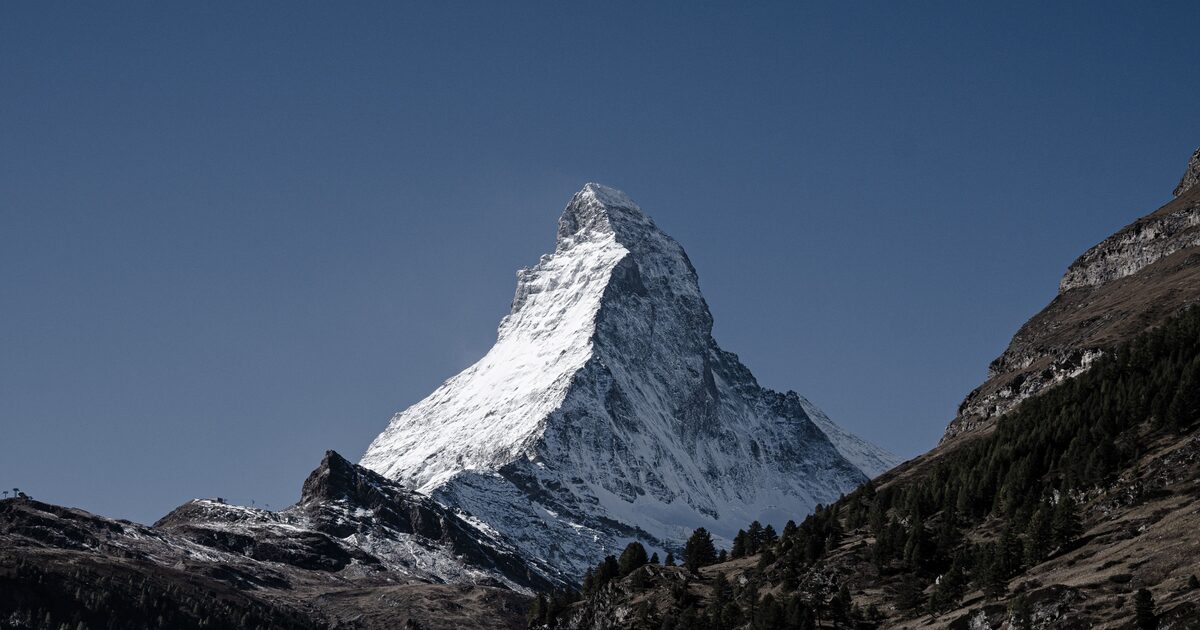
Here’s the quiet geographical detail in all of this: the Matterhorn of your imagination — the sharp, slightly hooked pyramid on the Toblerone packaging and half the world’s chocolate boxes — is specifically the view from Zermatt, looking at the east and north faces stacked along the Hörnli ridge, the very line of the 1865 climb and the fall. From Italy the mountain is just as dramatic but broader and blockier; it’s the Swiss angle, publicized by the disaster and a century and a half of Zermatt tourism, that became the global icon.
That’s why the Matterhorn earns its place among the peaks everyone knows on sight — we’ve ranked it against the other unmistakable summits in our guide to the most recognizable mountains in the world. Few silhouettes carry this much history in one outline: point a camera at it from the Zermatt side and you’re framing not just a 4,478 m pyramid, but the exact skyline where the golden age of alpinism ended in a single broken rope.
The real peaks
Genuine photographs of the summits above — so you know what to actually look for: